
Sold by: Anvilogic
Detection engineering teams love using Anvilogic's Multi-SIEM Detection Platform to quickly close detection gaps and reduce costs.
4.3
Overview
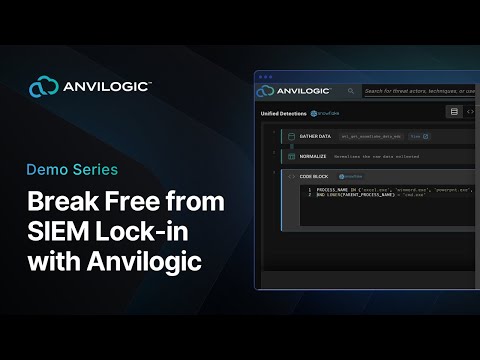
Anvilogic breaks the SIEM lock-in that drives detection gaps and high costs for enterprise SOCs. It enables detection engineers and threat hunters to keep using their existing SIEM while seamlessly adopting a scalable and cost-effective data lake for high-volume data sources and advanced analytics use cases. By eliminating the need for rip-and-replace, Anvilogic allows security leaders to confidently join the rest of the enterprise on the modern data stack without disrupting existing processes. Security operations teams at banks, airlines, and large tech companies use Anvilogic's modular detection engine, thousands of curated threat scenarios, and AI security copilot to improve detection coverage and save millions of dollars. Private offer only. Offered plans are by an organization's employee count, and offer can also include Copilot, Insights and/or Unified Detect add-ons.
Highlights
- Leverage thousands of ready-to-deploy detections across multiple query languages (SPL, SQL, KQL) with new detections released weekly by the Anvilogic Forge Team.
- AI-Powered recommendations for automated tuning, maintenance and health insights
- Customize and scope your most relevant MITRE ATT&CK techniques
Details
New
Introducing multi-product solutions
You can now purchase comprehensive solutions tailored to use cases and industries.

Features and programs
Buyer guide
Gain valuable insights from real users who purchased this product, powered by PeerSpot.

Financing for AWS Marketplace purchases
AWS Marketplace now accepts line of credit payments through the PNC Vendor Finance program. This program is available to select AWS customers in the US, excluding NV, NC, ND, TN, & VT.

Pricing
Pricing is based on the duration and terms of your contract with the vendor. This entitles you to a specified quantity of use for the contract duration. If you choose not to renew or replace your contract before it ends, access to these entitlements will expire.
Additional AWS infrastructure costs may apply. Use the AWS Pricing Calculator to estimate your infrastructure costs.
Dimension | Description | Cost/12 months |
|---|---|---|
Anvilogic Core Detect 2k Employees | Anvilogic Core Detect: Up to 3 seats | $80,000.00 |
Anvilogic Core Detect 5k Employees | Anvilogic Core Detect: Up to 10 seats | $185,000.00 |
Anvilogic Core Detect 20k Employees | Anvilogic Core Detect: Up to 20 seats | $310,000.00 |
Anvilogic Core Detect 100k Employees | Anvilogic Core Detect: Up to 30 seats | $575,000.00 |
Anvilogic Core Detect Additional Seat (qty 1) | Anvilogic Core Detect: Additional Seat | $3,000.00 |
Anvilogic Core Detect Additional Employees (qty 100) | Anvilogic Core Detect: Additional Employees | $1.00 |
Anvilogic Copilot Additional Questions (qty 1) | Additional questions, only applicable to Copilot purchase. | $1.00 |
Vendor refund policy

Legal
Vendor terms and conditions
Upon subscribing to this product, you must acknowledge and agree to the terms and conditions outlined in the vendor's End User License Agreement (EULA) .
Content disclaimer
Vendors are responsible for their product descriptions and other product content. AWS does not warrant that vendors' product descriptions or other product content are accurate, complete, reliable, current, or error-free.
Delivery details
Software as a Service (SaaS)
SaaS delivers cloud-based software applications directly to customers over the internet. You can access these applications through a subscription model. You will pay recurring monthly usage fees through your AWS bill, while AWS handles deployment and infrastructure management, ensuring scalability, reliability, and seamless integration with other AWS services.
Resources
Vendor resources
Support
Vendor support
AWS infrastructure support
AWS Support is a one-on-one, fast-response support channel that is staffed 24x7x365 with experienced and technical support engineers. The service helps customers of all sizes and technical abilities to successfully utilize the products and features provided by Amazon Web Services.
Updated weekly
By Anvilogic

By CardinalOps

By SentinelOne
Sentiment is AI generated from actual customer reviews on AWS and G2
Functionality
Ease of use
Customer service
Cost effectiveness
Positive reviews
Mixed reviews
Negative reviews
AI generated from product descriptions
Multi-SIEM Compatibility
Support for multiple query languages including SPL, SQL, and KQL enabling detection deployment across different SIEM platforms without rip-and-replace migration
Pre-built Detection Library
Thousands of curated threat scenarios and ready-to-deploy detections with weekly updates from the detection engineering team
AI-Powered Detection Optimization
Automated tuning, maintenance, and health insights powered by AI recommendations for detection rules and security operations
MITRE ATT&CK Framework Integration
Ability to customize and scope detection rules aligned with specific MITRE ATT&CK techniques for targeted threat coverage
Modular Detection Engine
Scalable detection architecture supporting high-volume data sources and advanced analytics use cases alongside existing SIEM infrastructure
MITRE ATT&CK Framework Integration
Continuous assessment and mapping of detection coverage against MITRE ATT&CK framework to measure depth of detection coverage across attack techniques and layers.
Multi-SIEM Native Integration
Native API integration with major SIEM and detection platforms including Splunk, Microsoft Sentinel, IBM QRadar, Google Chronicle, CrowdStrike LogScale, and Sumo Logic Log Analytics.
Automated Detection Rule Customization
Automatic generation of deployment-ready detection rules customized to organization's environment including log sources, field mappings, thresholds, exclusions, and naming conventions.
Detection Rule Audit and Remediation
Automated identification and remediation of broken, noisy, and missing detection rules with validation using historical SIEM data.
Threat Intelligence Operationalization
Conversion of TTP-level threat intelligence reports from commercial sources and open-source intelligence into actionable detection rules with deployment recommendations.
AI-Powered Threat Detection and Response
Real-time threat detection and automated response capabilities augmented by advanced AI and automation across endpoints, cloud workloads, and identity infrastructure.
Cloud Workload Protection
Runtime threat protection for Amazon EC2 instances, EKS clusters, and AWS Fargate with autonomous blocking of malware, ransomware, and fileless attacks.
Extended Detection and Response
Correlated view of full attack stories across endpoints, identities, and cloud workloads using patented Storyline technology to automatically correlate and contextually group related events.
Identity Threat Detection and Response
Continuous monitoring and protection against credential theft, privilege escalation, and lateral movement attacks across Active Directory and cloud identity providers including Entra ID, Okta, Ping, SecureAuth, and Duo.
Generative AI Security Analysis
Generative AI security analyst that automates threat hunting, provides incident summaries, and accelerates investigations through machine-speed analysis.
Validated by AWS Marketplace
FedRAMP
GDPR
HIPAA
ISO/IEC 27001
PCI DSS
SOC 2 Type 2
No security profile
No security profile
-
-
-
-
-
Standard contract
No
No
Customer reviews
Ángel García Favieres
Detection workflows have become streamlined and support efficient alert and allow-list management
Reviewed on Jun 23, 2026
Review provided by PeerSpot
What is our primary use case?
My main use case for Anvilogic is for detection engineering, and I manage all of my use cases and alerts in the AVLs through Anvilogic .
A specific example of how I use Anvilogic for detection engineering and managing alerts is that we use it with Splunk, and through the Splunk logs that we send and store there, we create logics for user logins when they shouldn't have access, brute force cases, and other detection scenarios.
I also use Anvilogic for allow listing. As much as I use it for logics, I also allow list with the tool. It has some capabilities for researching my infrastructure and identifying which use cases I would need or which defenses I have covered insufficiently.
What is most valuable?
In my opinion, the best features Anvilogic offers are the AVLs and the logics, which are pretty user-friendly. It has extensive mapping with MITRE frameworks and various other capabilities.
The user-friendly AVLs and mappings help in my day-to-day work because the AVLs are readable and understandable rather than appearing as disorganized code that is difficult to comprehend. I can use macros to assist myself. Allow listing is also user-friendly because it has its own process where I choose a field first and then allow list something in that field.
Anvilogic has positively impacted my organization because I started working with this organization after they implemented Anvilogic. I would say it is much easier to create all the use cases and detection engineering tasks with Anvilogic integrated with Splunk. They are implementing some AI features that I would like to test out and am still waiting to try. The fact that it is easier to create use cases and engineering tasks has made my daily work more efficient with all the filtering capabilities that Anvilogic provides.
What needs improvement?
I would not say there is anything I would like to add regarding how Anvilogic can be improved, as they are probably working on many improvements already. I do not think there is anything that could make my experience better right now.
For how long have I used the solution?
I have been using Anvilogic for about six months.
What do I think about the stability of the solution?
In my experience, Anvilogic is stable, as we have not encountered any problems with the platform and the tool.
What do I think about the scalability of the solution?
Anvilogic's scalability is pretty good.
How are customer service and support?
The customer support is excellent. We have communicated with customer support frequently, and they always try to help and actively reach out to us. I would rate the customer support a ten.
Which solution did I use previously and why did I switch?
I think we were using raw Splunk before Anvilogic.
What other advice do I have?
My advice to others looking into using Anvilogic is to absolutely go for it and feel free to test with the tool because it is very good and I appreciate it greatly. Anvilogic is a very good tool that I like to use because it is intuitive, user-friendly, and it helps significantly with detection engineering tasks. I rated this review an eight overall.
Evans Vasavan
Automation has transformed threat hunting and has reduced false positives in daily investigations
Reviewed on May 11, 2026
Review from a verified AWS customer
What is our primary use case?
Anvilogic serves as my cybersecurity company's platform that provides detection, SIEM support, and SOC investigation, along with the implemented MITRE ATT&CK framework.
A specific example of how I use Anvilogic in my daily work is that it provides threat detection, reports, detailed reports, detection engineering, and threat hunting, which is quite good.
Anvilogic's threat hunting feature has made my work easier because it supports advanced threats and attack scenarios, analyzing across platforms to detect both known and unknown threats, which proves very useful for my organization.
Anvilogic has changed how my team thinks about detection by improving detection engineering, reducing false-positive alerts, and integrating hybrid SIEM and data lake architectures, and so far, it has been beneficial.
What surprised me the most about Anvilogic once I started using it is the automation capability, which automatically detects and investigates threats such as malware and provides us with reports, making the automation aspect very strong in this software.
Since onboarding, my usage has evolved. During the first 90 days, the software wasn't configured properly, and we were just understanding its basics. As use cases increased daily, we altered and modified some policies and rules to reduce false-positive reports.
What is most valuable?
Anvilogic's best features are detection, SIEM support that is logged into the SIEM, AI detection in the SOC workflow, as well as threat detection and correlation of that particular software.
Anvilogic's AI detection in the SOC workflow stands out compared to other solutions I've tried because the accuracy of the AI makes it the best software for my organization. The AI agent assists with detection and threat creation, analyzes behaviors, and triggers alerts if any suspicious behavior occurs, along with investigation and MITRE ATT&CK mapping, which helps me significantly.
Anvilogic has positively impacted my organization by helping with both known and unknown threats already present in the current threat landscape, detecting SIEM tools such as Splunk, Microsoft Sentinel, Snowflake, and Databricks, optimizing those tools, and strengthening my organization in the cybersecurity realm.
I have seen a reduction in response time as a specific outcome. Due to SIEM modernization and SOC automation, it has helped me significantly by reducing false-positive reports and alerts.
What needs improvement?
I chose a nine because, while Anvilogic is excellent, there is room for improvement in terms of the false-positive reports that have been presented and the AI pattern that can be improved.
For how long have I used the solution?
I have been using Anvilogic for three years.
What do I think about the stability of the solution?
Anvilogic is quite stable.
What do I think about the scalability of the solution?
On a scale of one to ten, I would rate Anvilogic's scalability as a nine.
How are customer service and support?
The customer support of Anvilogic is good and quite responsive.
Which solution did I use previously and why did I switch?
We did not previously use any different solution and directly switched to Anvilogic.
How was the initial setup?
Before choosing Anvilogic, we did not evaluate other options and directly purchased it from a vendor who offered it to improve our organization's capabilities. After trying it for two years, it has been working well.
What about the implementation team?
I am from the technical department, so I do not have details about pricing, setup cost, or licensing, as that was handled by my management team.
What was our ROI?
I am not certain about return on investment, but I can say it is meeting what I needed and what is necessary for the organization.
What's my experience with pricing, setup cost, and licensing?
I am from the technical department, so I do not have details about pricing, setup cost, or licensing, as that was handled by my management team.
Which other solutions did I evaluate?
We did not previously use any different solution and directly switched to Anvilogic. Before choosing Anvilogic, we did not evaluate other options and directly purchased it from a vendor who offered it to improve our organization's capabilities. After trying it for two years, it has been working well.
What other advice do I have?
My advice to others looking into using Anvilogic is that they should try it at least once by conducting a proof of concept, and if their use cases are met, they can proceed with confidence.
When other teams ask about Anvilogic, I tell them it has helped significantly and has reduced work in reporting and investigation within my organization since adoption.
I have not considered what would break first if Anvilogic disappeared, but I would say the automation capability and reporting would negatively impact my organization.
Looking 12 months ahead, I see Anvilogic playing a bigger role as features evolve rapidly. Any improvements in false-positive reports or new features would definitely enhance its role in my organization.
The need for something better was triggered by the various threats present in the world, which needed to be improved and detected. For that reason, we chose to purchase this software, and having worked on it for the past two years, it satisfies our organizational use cases.
I rate this review a nine overall.
Which deployment model are you using for this solution?
Public Cloud
If public cloud, private cloud, or hybrid cloud, which cloud provider do you use?
Amazon Web Services (AWS)
reviewer2802372
Ai-driven detection has reduced false positives but data ingestion still needs improvement
Reviewed on Feb 11, 2026
Review from a verified AWS customer
What is our primary use case?
Anvilogic serves as our main SIEM and detection engineering platform. We use Anvilogic to create alerts based on our data, and the AI capability to detect alerts based on whatever data we are feeding into it is a feature that our team at Kroll particularly values.
We have SentinelOne data, which is our EDR, and we have EDR data directly set up through Anvilogic input without using any third-party tool to get that data. Anvilogic has integrations directly in place, and we are using the SentinelOne input through Anvilogic. Since we uploaded or ingested that data, Anvilogic has started to give us suggestions about what alerts could be fired through that data. Anvilogic has flagged the threat identifiers through which we can build some use cases or modify them for our use. Anvilogic has also helped us understand what is a false positive and what could be a promising use case for our company in particular, providing valuable support.
Regarding how Anvilogic supports our detection engineering, the uniqueness is about AI, which we did not have in Splunk earlier. This helps us not only to close the false positives but also features AI to write our queries. This capability lifts a lot of burden from the SOC team as they do not have to focus on how to write a query but can concentrate on investigating an alert or a use case, which has really caught my eye, and I am glad we have onboarded that feature.
How has it helped my organization?
Anvilogic has positively impacted our organization with a significant decrease in false positives and providing the independence of multiple data repositories, allowing us the choice of having different repositories. This flexibility enhances our operational efficiency, and the AI also assists with writing queries, making it scalable and cost-effective as we can adjust according to our needs.
What is most valuable?
The best features that Anvilogic offers include its independence from a particular solution, allowing us to have Snowflake as a data repository now and the flexibility to move to other platforms such as Databricks or Splunk while keeping our detections intact. Another valuable feature is the AI capability, which not only assists in detection but also helps us to write queries, completing multiple tasks efficiently. Additionally, Anvilogic is a no-code platform, so the base search is already ready for us, and we just have to tweak it according to our use cases. Anvilogic's new features enable us to improve SOC efficiency and filter out a lot of false positive alerts. Additionally, it has an attached MITRE framework, automatically detecting it so we do not have to manually add the MITRE framework IDs as we did in Splunk.
Among those features, the one that has made the biggest difference for our team is the AI capability; we have seen a significant shift in our SOC operations. Many false positives are handled by the AI, allowing the team more time to discuss and investigate the actual use cases. Each use case also includes a description of what it is trying to detect, which helps engineers understand the use case's purpose without needing to reach out to seniors for clarification.
What needs improvement?
Currently, there is a limitation of 100 inputs in Anvilogic integrations, which is less than our needs, making it a challenge to fit all our inputs. Additionally, I believe the documentation should be publicly accessible. We work with different teams to get the data, but since the documentation is not available to everyone, we often have to explain how to make integrations. Also, there are features that do not work as expected; for example, we recently tried to ingest an AWS CloudTrail input to which Anvilogic could not accept any more data past a certain point, forcing us to look for alternatives. We have found that data mapping is sometimes not adequate, as it can only parse JSON data, contrary to the documentation suggesting that CSV or XML formats are acceptable, which has caused issues.
For how long have I used the solution?
I have been working in my current field for three years, and it has been one year that we have moved to Anvilogic. Prior to that, we were using Splunk as our data ingestion platform and as well as SIEM.
What do I think about the stability of the solution?
Anvilogic is somewhat stable. Regarding data inputs, we have had issues, but in terms of downtime, we have not experienced any.
What do I think about the scalability of the solution?
Anvilogic is quite scalable, allowing us to significantly lower storage and processing costs compared to legacy SIEM-only approaches. Thanks to having a different data repository, we do not crowd Anvilogic with data and accordingly adjust it to our specific needs.
How are customer service and support?
Customer support is generally good, though we sometimes have to wait longer for answers, which can be a bit frustrating, but overall the support is satisfactory.
How would you rate customer service and support?
Positive
Which solution did I use previously and why did I switch?
We were previously using Splunk and decided to switch due to its lack of AI capabilities related to the SIEM product. We also evaluated other options before settling on Anvilogic.
What other advice do I have?
The AI capabilities mentioned on Anvilogic's website are indeed good and promising; however, there are areas that require work, particularly concerning data ingestion. Users may encounter roadblocks while integrating inputs, as we faced significant delays due to data input inconsistencies.
Initially, the triage piece was not integrated into Anvilogic's UI, but since its integration, it has helped the team to easily check the triage dashboard and assess current use cases, encouraging us to continue seeking new ways to use it more efficiently.
The moment we realized we needed something better was triggered by Splunk's lack of AI integration, which prompted my manager to consider Anvilogic due to its promising AI features. Since onboarding, we have evolved to remove false positives effectively, which was a challenge with Splunk, allowing for fewer alerts due to Anvilogic's capabilities. Additionally, we no longer need to be dependent on a particular data repository, benefiting from the flexibility that Anvilogic provides.
I rate Anvilogic a six out of ten. I chose a six out of ten for Anvilogic because, despite the impressive detection capabilities and intriguing features, I still see a need for improvement with the data ingestion process. If the data is not ingested properly, the detections could be compromised. While it excels at detection and offers good use cases, my personal experiences with certain problems influenced the decision to rate it just above average.
Which deployment model are you using for this solution?
Public Cloud
If public cloud, private cloud, or hybrid cloud, which cloud provider do you use?
Amazon Web Services (AWS)
Kevin Hernandez
Platform has transformed incident triage and correlation while reducing detection costs
Reviewed on Feb 03, 2026
Review provided by PeerSpot
What is our primary use case?
What is most valuable?
I currently utilize multiple of Anvilogic's AI features, both for fine-tuning and developing new content, as well as the threat intelligence feeds that it provides.
In my opinion, the best features Anvilogic offers are the AI features, which are great, and their common language rule tuning and modeling is much simpler than those other vendors that require query building skills.
The common language rule tuning and modeling have made things easier for my team because it is broken down into multiple smaller chunks rather than one large chunk of code. Multiple smaller, pre-processed data points are basically visible and editable in those smaller chunks without having to actually code at all.
Anvilogic has impacted my organization positively because it is native for cloud-type infrastructures and they have a significant proactive approach to cost licensing. Rather than having to import all data, it actually sits on top of Snowflake , which reduces overall cost for data storage itself. Since implementing Anvilogic, our overall costs have been reduced.
What needs improvement?
Anvilogic can be improved further by maturing certain intelligence aspects outside of articles. This is an aspect that lacks in most SIEM and secure analytics tools, but personally the framework or "barebone" is in Anvilogic, it just needs further maturing
For how long have I used the solution?
I have been using Anvilogic for six months.
What do I think about the stability of the solution?
Anvilogic is stable.
What do I think about the scalability of the solution?
Anvilogic's scalability is good and it scales properly.
How are customer service and support?
I have not directly worked with customer support since I am a manager, but I have not heard any complaints from my employees.
Which solution did I use previously and why did I switch?
I previously used top tier SIEM 's. I switched to Anvilogic because it looked overall better and proved to be a better fit for our type of architecture.
What was our ROI?
I have seen a return on investment in the form of time saved developing new content.
What's my experience with pricing, setup cost, and licensing?
My experience with pricing, setup cost, and licensing was straightforward. They provide estimates because obviously every business is different, but they provided reasonable estimates that were fairly accurate based on other customers from a similar type of background or size.
Which other solutions did I evaluate?
Before choosing Anvilogic, I evaluated other options. including vendors in the top quadrant
What other advice do I have?
Anvilogic has changed how my team thinks about detection and data usage because it makes it easier to follow than other tool sets. Since a lot of the content is dynamic, you can follow the trail in the threat hunt perspective compared to other tools where you have to manually recreate a new query to investigate the action further.
The moment that led me to choose Anvilogic was triggered because we normally evaluate vendors every so often to make sure we have a proper solution in place.
My usage of Anvilogic has evolved since onboarding and it is a bit more mature now, which certainly does help.
When other teams ask about Anvilogic, I tell them that it is fairly good.
There has not been anything that has become easier to justify or explain to leadership since adopting Anvilogic.
My advice to others looking into using Anvilogic is to conduct a test or proof of concept based on your actual future stance so that you feel the proper controls and everything is adequate to where you want to go.
I am looking forward to seeing how the tool will evolve and grow, especially with the AI features. I would rate this product overall as a 9 out of 10.
Joe Moore
Detection engineering has become consistent and now coordinates multi-platform threat rules
Reviewed on Jan 31, 2026
Review provided by PeerSpot
What is our primary use case?
My main use case for Anvilogic is coordinating and tracking indicators of compromise and detection rules. I use Anvilogic for coordinating and tracking indicators of compromise or detection rules by feeding detection rules into Splunk, our Splunk environment, and these are turned into actionable alerts for our security operations center.
How has it helped my organization?
Anvilogic has positively impacted my organization by being a force multiplier for our security operations center and has allowed us to coordinate and distribute work more efficiently and provide consistency among the multiple SIEM environments.
I was able to create 90 detection scenarios in the first two weeks of using Anvilogic, which showcases how it improved efficiency and consistency for my team.
What is most valuable?
The best features Anvilogic offers are consistent recording and tracking of detection engine detection rules as they adapt over time to adversary's behaviors, and the ability to operate in multiple security SIEM environments.
Anvilogic works for my team by providing a single point of contact to put detection engineering rules that then get distributed to all of the various event management engines, as we have multiple SIEM environments in our company, including Microsoft Defender, Splunk, Elastic, and others.
Anvilogic has changed how my team thinks about detection by allowing us to no longer apply the same configurations and correlation rules in multiple Splunk environments and can transparently search across multiple SIEMS platforms.
What surprised me the most about Anvilogic once I started using it is the ease of creating and maintaining custom threat intel and threat scenarios.
What needs improvement?
Anvilogic can be improved with more support for cross-platform and native detection languages such as Sigma and Yara rules.
For how long have I used the solution?
I have been using Anvilogic for about six months.
What do I think about the stability of the solution?
Anvilogic has been very stable and reliable.
What do I think about the scalability of the solution?
Anvilogic's scalability has been great as it has been able to scale and perform well, better than the available resources we have to throw at it, and we have not run into any issues with our analysts not being able to access Anvilogic and perform their activities efficiently.
How are customer service and support?
Anvilogic customer support has been very productive to work with.
What was our ROI?
I have seen a return on investment in that Anvilogic has been more of a fundamental enablement technology than a return on investment, but it has definitely allowed us to move more quickly with integrating our corporate acquisitions as well as with our corporate colleagues who use other SIEM technologies.
What other advice do I have?
When other teams ask about Anvilogic, I tell them it makes detection engineering into a process rather than a one-time operation.
I convinced my leadership to adopt Anvilogic by comparing it to the manual operations and the overhead of repeated detection engineering processes.
My advice for others looking into using Anvilogic is to start with the configurations and detection rules that come prepackaged, and then reach out and create your own to expand your capabilities; once you start using this system, it becomes much easier and more efficient than manually maintaining detection rules.
I provide this review with a rating of 10.