
Sold by: Accenture
Drive delivery of impactful digital assistant experiences with Accenture experts and a leading AI platform.
4.1
Overview
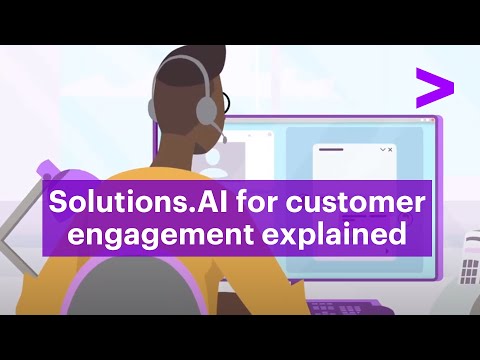
Conversational AI Platform is a middleware solution for building and operating robust and comprehensive conversational AI solutions including virtual agents, chatbots, voice assistants and more. It allows organizations to fully manage their conversational AI solution, with modules for RPA design, execution, analytics, and agent escalation.
CAIP also provides more than 80 industry cartridges out of the box that can be easily tailored to organizational requirements. There is also a growing ecosystem of available integrations with customer relationship management software and other enterprise programs and platforms.
CAIP eases call volume surges, reduces wait times, improves customer satisfaction, and facilitates continuous improvements through AI and machine learning. In the middle of the response to the COVID 19 pandemic, customers have proven that frequent changes to existing and new conversations can be rapidly deployed to address an organic landscape of interactions and needs.
CAIP is purpose built to handle complex ecosystems, bringing together legacy, hybrid and cloud elements to create one cohesive solution that not only improves the user experience, but delivers real business value.
Accenture uses AWS Private Offers to extend custom pricing, scope, EULA, and contract terms. Please contact us at AWS-Marketplace@accenture.com for more information about Private Offers.
Highlights
- Accelerate pace to deliver: Pre-built technical integrations and reusable components speed up implementation.
- Operate and scale a living system: Centralizing creation, publishing and maintenance of experiences helps organizations to break traditional silos and enables scaling across the enterprise.
- Leverage pre-built conversational experiences: Access an ever-evolving library of use cases created by designers and subject matter experts that are ready to be rolled out for a range of industries.
Details
Sold by
Delivery method
Deployed on AWS
New
Introducing multi-product solutions
You can now purchase comprehensive solutions tailored to use cases and industries.

Features and programs
Buyer guide
Gain valuable insights from real users who purchased this product, powered by PeerSpot.

Financing for AWS Marketplace purchases
AWS Marketplace now accepts line of credit payments through the PNC Vendor Finance program. This program is available to select AWS customers in the US, excluding NV, NC, ND, TN, & VT.

Pricing
Pricing is based on the duration and terms of your contract with the vendor. This entitles you to a specified quantity of use for the contract duration. If you choose not to renew or replace your contract before it ends, access to these entitlements will expire.
Additional AWS infrastructure costs may apply. Use the AWS Pricing Calculator to estimate your infrastructure costs.
Dimension | Description | Cost/12 months |
|---|---|---|
Premium Tier | Premium CAIP offering with Voice and Text Channels | $180,000.00 |
Vendor refund policy
Contact seller for refund policy

Legal
Vendor terms and conditions
Upon subscribing to this product, you must acknowledge and agree to the terms and conditions outlined in the vendor's End User License Agreement (EULA) .
Content disclaimer
Vendors are responsible for their product descriptions and other product content. AWS does not warrant that vendors' product descriptions or other product content are accurate, complete, reliable, current, or error-free.
Delivery details
Software as a Service (SaaS)
SaaS delivers cloud-based software applications directly to customers over the internet. You can access these applications through a subscription model. You will pay recurring monthly usage fees through your AWS bill, while AWS handles deployment and infrastructure management, ensuring scalability, reliability, and seamless integration with other AWS services.
Support
Vendor support
AWS infrastructure support
AWS Support is a one-on-one, fast-response support channel that is staffed 24x7x365 with experienced and technical support engineers. The service helps customers of all sizes and technical abilities to successfully utilize the products and features provided by Amazon Web Services.
Updated weekly

Top
25
In Speech Recognition
Top
10
In Contact Center, CRM, IT Business Management
Top
10
In Contact Center
Sentiment is AI generated from actual customer reviews on AWS and G2
Functionality
Ease of use
Customer service
Cost effectiveness
Positive reviews
Mixed reviews
Negative reviews
AI generated from product descriptions
Robotic Process Automation Integration
RPA design and execution modules integrated within the platform for automating business processes
Pre-built Industry Templates
Over 80 industry cartridges available out of the box that can be customized for organizational requirements
Multi-channel Conversational Interfaces
Support for building virtual agents, chatbots, voice assistants and other conversational AI solutions
Analytics and Performance Monitoring
Analytics modules for tracking and monitoring conversational AI solution performance and interactions
Enterprise System Integration
Ecosystem of integrations with customer relationship management software and other enterprise platforms to connect legacy, hybrid and cloud elements
Omnichannel Communication
Support across multiple channels including web, social, mobile, voice, messaging, live chat, and email with seamless conversational experiences
Knowledge Management
Comprehensive knowledge graph and knowledge management system integrated with unified agent workspace for complete customer context
Pre-built and Custom Integrations
Over 1,200+ pre-built integrations available on the Zendesk App Marketplace with tools to create and configure custom experiences
Real-time Reporting and Analytics
Real-time reporting and analytics capabilities with measurement and insights for continuous monitoring and improvement of service metrics
Omnichannel Engagement Platform
Native omnichannel engagement applications including voice engagement, studio and routing capabilities for customer interactions across multiple channels
AI-Powered Automation
AI-powered virtual agents, agent assist, AI trainer, and generative AI solutions for automating customer service processes and enhancing agent capabilities
Unified Analytics and Reporting
Integrated customer experience analytics with live and explore standard reporting, dashboards, and workflows accessible through a single pane of glass interface
Workforce and Knowledge Management
Workforce engagement management, employee collaboration tools, and knowledge management capabilities with over 70 out-of-the-box integrations
API Access and Extensibility
API access and open platform architecture with a common data model enabling custom integrations and extensions
Standard contract
No
No
No
Customer reviews
Yatin Parmar
Automated support has transformed customer service and now reduces repetitive workloads
Reviewed on Jun 23, 2026
Review from a verified AWS customer
What is our primary use case?
Our primary use case for Accenture Conversational AI is automating customer service integration and handling repetitive queries. We use Accenture Conversational AI to answer FAQs, assist with account-related requests, and for complex cases, we escalate to human agents. The goal was to improve response time and reduce the operational load on support teams. It became a key part of our digital support strategies.
One of the projects involved the deployment of a customer support chatbot on an online service platform, receiving nearly 20,000 inquiries every month. The chatbot automated tasks including order tracking, password reset, and account updates. Within three months, it was resolving nearly 65% of incoming requests without human intervention. This significantly improved customer satisfaction and reduced agent workload.
Beyond customer support, we have also used Accenture Conversational AI for internal services, employee questions about policies, and onboarding. We have integrated it with various APIs and created an unparalleled experience. It provides value beyond customer-facing applications.
What is most valuable?
The strongest feature of Accenture Conversational AI is the click-to-build conversation workflow while still allowing customization and integration capabilities. The concept is easier to understand. I also appreciate the insight to continuously improve flexibility.
Our processes with the file handling feature were helpful. The team and delivery process is faster than our previous deployment approach. Instead of spending several months building the interfaces from the ground up, we are focusing on business logic and user experience. The analytics helped identify common user issues, improve things interactively, and increase team productivity significantly.
Accenture Conversational AI's channel deployment allowed us to deploy the same conversation experience across the website and messaging channels. The platform handled the integration with digital media complexity and helped us scale efficiently for our use cases.
What needs improvement?
Accenture Conversational AI is good and capable, but there is still room for improvement around debugging some complex integration requirements. Additionally, the learning curve is somewhat steep. For teams with limited conversational AI experience, more guided documentation would be beneficial.
Some small improvements in monitoring for Accenture Conversational AI would be welcome. I would also appreciate more detailed implementation examples. These improvements would make things easier.
The platform is scalable and reliable, but a few points were deducted primarily for debugging and enhancement. That is the reason for choosing 8 out of 10.
What do I think about the stability of the solution?
From my experience, the accuracy and reliability of output from Accenture Conversational AI in production is very stable. We had very few unplanned disruptions during the implementation and even during periods of high traffic.
What do I think about the scalability of the solution?
Scalability has been one of Accenture Conversational AI's strongest qualities. As adoption increased, it was able to handle significantly higher volume. The platform's architecture adapts well to growing demand and new use cases. Scalability gave us confidence for future expansion.
How are customer service and support?
Our integration support for Accenture Conversational AI is generally positive. The team is responsive, knowledgeable, and met deadlines for implementation questions. Most of the issues were resolved in an acceptable timeline. The timeline accelerated problem resolution during critical cases. For customer support, I give it a 10.
Which solution did I use previously and why did I switch?
We previously relied heavily on manual customer support and processes. We switched to Accenture Conversational AI because we needed a more intelligent solution.
How was the initial setup?
Pricing and setup cost for Accenture Conversational AI was generally straightforward. The integration requirements and defining the business logic for automation involved planning, especially for the integration. Overall, the process was smooth.
What about the implementation team?
We use Accenture Conversational AI as a technology platform for our project. Our relationship was professional and centered around implementation and support activity. There is no partnership, financial interest, or specific commercial arrangement with the vendors.
What was our ROI?
We achieved significant savings, faster automation, and improved response time with Accenture Conversational AI. We reduced the dependency on manual support and processing. The efficiency gain was visible within a month after deployment. The productivity increase justified the investment.
What's my experience with pricing, setup cost, and licensing?
I purchased Accenture Conversational AI through the AWS marketplace. This was due to significant savings, faster automation, and improved response time with Accenture Conversational AI. We reduced the dependency on manual support and processing. The efficiency gain was visible within a month after deployment. The productivity increase justified the investment.
Which other solutions did I evaluate?
We evaluated a few other conversational AI platforms before choosing Accenture Conversational AI. While the products had strong features, Accenture had a better balance between enterprise-required customization and integration capability.
What other advice do I have?
I would advise others looking into using Accenture Conversational AI to start with clearly defined use cases and objectives. Also, involve business users in the testing. I gave this product a rating of 8 out of 10.
Muzi Maphophe
Conversational automation has transformed insurance consultations and improves customer personalization
Reviewed on Jun 18, 2026
Review from a verified AWS customer
What is our primary use case?
My main use case for Accenture Conversational AI has been in the insurance industry, helping several companies mainly with their voice assistance and chatbots. With generative AI emerging, we have been using a lot of NLP and ensuring that we keep operations alive even though there is no human being manning it.
A specific example of how I use Accenture Conversational AI for voice assistance in my insurance projects is mainly for consultations, where someone might find that what they are looking for is not found during a normal online consultation. They have the option to choose a voice assistant, which will help them customize a package in terms of what they want to insure and what they want to leave out. It is mainly used for custom packages that are not freely available.
What is most valuable?
The best features Accenture Conversational AI offers include its integration with legacy systems, which is quite complex because a lot of things are set in stone and you need a lot of innovation and technical ability to integrate these systems. I think it is a great accelerator in the insurance industry because it makes everything a little bit faster, way more accessible to users, and for the people receiving the information, it is easier to categorize and see and separate the data easily. I can see where our customer base is heading towards, what they are liking more, and what they like to include in their packages.
The accessibility and speed of Accenture Conversational AI have impacted my day-to-day operations by allowing us to work at speed without compromising quality. We appreciate that we are able to give our clients peace of mind.
What needs improvement?
The only thing that I have seen with Accenture Conversational AI is that for long-term operations, it comes a little bit more expensive. However, I am very thankful that working with companies that have been in the industry for so long makes it easier to integrate with legacy systems and gives a little bit more extensive support than other conversational AI solutions that I have worked with.
Accenture Conversational AI can be improved as it often requires custom development for implementation, which brings us to higher implementation costs. The costing around implementation is a very big conversation that we have been trying to get over that hurdle. Though the return on investment has not been that bad, the initial implementation costs are a little bit higher than other conversational AI solutions.
In terms of needed improvements, working with the Accenture team for technical implementation has been brilliant, but they just need to help us with the costing when it comes to implementation. In terms of features, we are quite happy with what we have, and they do give a lot of global support depending on where we are and what type of implementation we are doing.
For how long have I used the solution?
I have been using Accenture Conversational AI for quite some time, about two to three years.
What do I think about the stability of the solution?
In my experience, Accenture Conversational AI has been stable, with no downtime or issues. Clients are loving it, and any hiccups have usually occurred during implementation and testing.
What do I think about the scalability of the solution?
Accenture Conversational AI is quite easy to scale up or down depending on my needs, particularly if I am on cloud or private cloud. It is straightforward to communicate with the support team about pricing, space, and capability when it comes to scaling.
How are customer service and support?
Regarding Accenture Conversational AI's capabilities, I think its governance and security are really good, as we have not had any issues security-wise. How it is governed is in line with all the GDPRs and the POPI acts, with no significant issues on that front.
The accuracy and reliability of output from Accenture Conversational AI have been very consistent. I think it is one of its greatest strengths, and we are able to get great data in terms of that. The NLP setup is easier than most, and it also has some agent assist capabilities, which are very helpful.
Which solution did I use previously and why did I switch?
I have used other solutions before Accenture Conversational AI. Recently, we have been trying out Microsoft Copilot, which is cheaper, but most of the capabilities we are looking for are not there, making Accenture Conversational AI good in comparison.
We previously evaluated no other solutions before Accenture Conversational AI, as it was the only option we knew at that time, and we just went with it.
How was the initial setup?
Currently, I think Accenture Conversational AI is really great due to how we can customize the implementation, making it easy for us to align with different settings or scenarios. So far for me, it has been great, and we are going to start our third implementation soon, with each implementation having its unique nuances based on the company's wants, needs, and business goals.
What about the implementation team?
My experience with pricing, setup costs, and licensing for Accenture Conversational AI has been really great, as the team has been very helpful. However, I think the initial pricing is quite heavy. Hopefully, we can come to some agreement to reduce the original price as we get deeper into these different implementations. I have a good team of developers who understand what is needed and can meet deadlines, and Accenture's support team is also fantastic in teaching us how to handle things that might be new to us.
What was our ROI?
We have seen a return on investment from using Accenture Conversational AI, especially money-wise. In terms of agents needed, that has become less, and companies are pivoting toward employing people who are technically sound in the setup of Accenture Conversational AI instead of relying heavily on consultants. While I do not have the exact numbers, the waiting time and conversion rate sit currently between thirty and forty-five percent.
What's my experience with pricing, setup cost, and licensing?
In terms of metrics on how much time has been saved or conversion rates improved since I started using Accenture Conversational AI, I think we have cut down those calls to about thirty percent, which is quite good. In terms of converting a client, those numbers have been up by about thirty to forty-five percent, paving a new way of doing business for the insurance companies that we are consulting for.
What other advice do I have?
I rate Accenture Conversational AI an eight out of ten because, while it helps a lot, it is not an out-of-the-box product where you can just learn and implement on your own. You still need a lot of help from the Accenture team, plus the implementation cost plays a role. My overall review rating for Accenture Conversational AI is eight out of ten.
Which deployment model are you using for this solution?
Public Cloud
If public cloud, private cloud, or hybrid cloud, which cloud provider do you use?
reviewer2846073
Chat insights into culture data have boosted engagement and improved decision making
Reviewed on May 26, 2026
Review from a verified AWS customer
What is our primary use case?
We have a culture operating system where we provide a B2B application for organizations to log their culture, their values, and their behavior. We measure those values, the culture, and culture KPIs using Accenture Conversational AI 's platform to query, letting users query their culture data. This provides a chatting interface for our users so that they can chat with their culture data.
For example, if a chief people officer or chief culture officer wants to see how their organization is doing on a metric called innovation or psychological safety, they can directly chat with this interface. In the backend, Accenture Conversational AI figures out the query structure, queries our backend, and shows the answer.
There are many use cases, such as onboarding health checks to see how many employees have been onboarded and how many employees have signed up their culture values. We had all this data in our database, and Accenture Conversational AI was used to facilitate all types of conversations on our interface in Instill Chat.
What is most valuable?
The best feature Accenture Conversational AI offers is orchestration. It can understand the query really well, including the person, entity, and all other things from the semantic side.
It improved the experience for getting data in a natural language pattern in an NLP form, rather than through a chart or other formats, which was very useful.
Our NPS score actually improved by eight points by introducing this feature, Instill Chat, which is built on Accenture Conversational AI. That is one metric, and efficiency-wise, it was really good. The speed was good, and accuracy was fantastic.
The accuracy was phenomenal. Once we understood the UX, it was easy, but it took some time to familiarize ourselves with the platform. The accuracy and speed were phenomenal.
It felt pretty secure, and we had all the certificates from AWS and Accenture. Accenture Conversational AI was pretty reliable and accurate; I would rate it ten out of ten.
What needs improvement?
Accenture Conversational AI needs to fix some UX bugs, simplify the engineering onboarding, and reduce the cost.
The debugging of the tool needs to be simplified. When we were working with Accenture Conversational AI, we were not able to see the logs, debug the code, and address the errors we faced. The UX needs to be simplified for debugging.
Reducing the cost is another improvement needed for Accenture Conversational AI.
For how long have I used the solution?
We have used Accenture Conversational AI for quite a while, but not for an extended period. When it came out in 2024, we started using it for a year, then we switched to our internal platform.
What do I think about the stability of the solution?
Accenture Conversational AI is stable.
What do I think about the scalability of the solution?
Accenture Conversational AI seems pretty scalable to us, and we did not face any issues.
How are customer service and support?
Customer support was really good; they were there whenever we had a bug or UX issues, such as when we were not able to find the logs, and they were really helpful.
Which solution did I use previously and why did I switch?
I did not previously use a different solution before Accenture Conversational AI.
Before choosing Accenture Conversational AI, we were looking to build in-house, but we did not have the engineering expertise to build something like that.
How was the initial setup?
The setup process was straightforward for the setup costs and licensing.
What was our ROI?
We were selling our product much more easily, so our NPS score went up by eight to ten points. Those are the two metrics, and our revenue increased.
What's my experience with pricing, setup cost, and licensing?
We were using it for one year, and we paid a substantial amount.
Which other solutions did I evaluate?
Accenture Conversational AI is now very costly, and there are other cheaper solutions available in the market. We could actually build something in-house as well.
What other advice do I have?
We started using Accenture Conversational AI, and feature-wise, it is great, but the engineering side of this platform is really heavy, and the cost is very substantial. We had to switch to a cheaper platform, and right now we have built our own internal tool. We started with Accenture Conversational AI, but because of the UX issues, the bugs, and some issues with the engineering side, we had to move away. I would rate this product an eight out of ten.
Which deployment model are you using for this solution?
Private Cloud
If public cloud, private cloud, or hybrid cloud, which cloud provider do you use?
Amazon Web Services (AWS)
reviewer2835786
Automated hiring and project tracking have reduced my workload but debugging still needs improvement
Reviewed on May 05, 2026
Review provided by PeerSpot
What is our primary use case?
My main use case for Accenture Conversational AI is that I use it as a server HR as a hiring authority that asks questions to my peers or teammates and gets answers from them.
I also use Accenture Conversational AI to hire people for me, and I use it to keep track of the project and explain the project to me, the progress of the project, and how the project is working on a daily basis. I keep track of it.
What is most valuable?
The best features Accenture Conversational AI offers include its nice middleware, which is pretty lightweight and very library, which is nice. There is also GenAI which is nice, and it helps in doing everything. It is pretty cool.
I do not need to code anything with Accenture Conversational AI; it is just automated. Everything is there, and I just have to use the service for my own work, which is very nice and easy to work with.
Accenture Conversational AI has positively impacted my organization, as I need to spend more time myself. Since it is an automated OS and automated process orchestrator, we basically have to spend less time on our participant or teammate or yourself.
What needs improvement?
I believe Accenture Conversational AI can be improved by making it more simplified, especially the debugging part of why something is not working. We can automate that thing itself.
We should also need an explainable AI on top of Accenture Conversational AI for more transparency on the model and the confidence.
For how long have I used the solution?
I have been working in my current field for the last three years, and this will be my last year, which is my fourth year.
What do I think about the stability of the solution?
Accenture Conversational AI is buggy at times, but the rest of the time it is fine.
How are customer service and support?
The customer service rating is three out of ten.
Which solution did I use previously and why did I switch?
I have not used a different solution previously.
What was our ROI?
I cannot share any relevant metrics with you regarding return on investment, such as fewer employees needed, money saved, time saved, or anything else, due to the policies.
What's my experience with pricing, setup cost, and licensing?
My experience with pricing, setup cost, and licensing is that pricing is a little on the higher side, and the setup cost, if it is worth it, then it is worth it. However, pricing is a little on the higher side.
What other advice do I have?
My advice to others looking into using Accenture Conversational AI is do not use it. I would rate Accenture Conversational AI a seven out of ten. I chose seven out of ten because while most of the things are nice, there is still room for improvement. My overall review rating for Accenture Conversational AI is seven.
Pranay Jain
Automation has reduced repetitive hiring queries and improves candidate support efficiency
Reviewed on Apr 27, 2026
Review from a verified AWS customer
What is our primary use case?
The main use case for Accenture Conversational AI is that while scaling Hiretual, we evaluated multiple infrastructure options and needed to address repetitive queries such as interview status, scheduling, and application status from both candidates and recruiters. We needed improved response time and enhanced candidate experience, which is why we integrated this bot with the Node.js backend APIs.
Accenture Conversational AI helped with those repetitive queries between candidates and recruiters by allowing candidates to check application statuses through our application handle and conduct interview scheduling from the enterprise side. We used the AI bot to automate candidate support, as candidates were raising repetitive queries via email and manual support. We needed to reduce dependency on human intervention, so we built the chatbot with predefined dynamic responses, resulting in 60% to 70% of the queries being handled automatically and achieving faster resolution times.
In addition to the main use case, we also focused on intent recognition and understanding users' query patterns, along with entity extraction for details such as job ID and candidate ID. We maintained conversational flow and addressed issues where chatbot responses were generic or inaccurate, leading us to improve intent definitions and train the chatbot with various candidate queries and contextual flows. For instance, we ensured predefined answers for frequently asked queries, which significantly enhanced accuracy and reduced user frustration.
What is most valuable?
The best feature of Accenture Conversational AI is its ability to redefine intent. Candidates in Hiretual ask similar questions in different ways, such as what is my application status or what stage am I in right now, so we employed the platform's intent recognition capability to train and refine responses over time, leading to high accuracy and improved understanding of user queries.
Accenture Conversational AI has positively impacted my organization by handling 60% to 70% of common candidate queries automatically, which reduced reliance on manual support and improved accuracy after several iterations. The structured intent and entity framework, along with a user-friendly interface for training phrases and easy integration with Node.js backend APIs, played crucial roles in this success, though the setup requires continuous improvement rather than being a one-time effort.
What needs improvement?
Training and refining the intent recognition on Accenture Conversational AI has not been straightforward, as we needed extensive data for training the AI chatbot and faced a learning curve in managing diverse candidate queries during the implementation process. Initially, the training was moderately easy thanks to the structured intent and entity setup, and we created various training phrases such as check status and application status.
Accenture Conversational AI can be improved due to the initial learning curve for training data, as it sometimes misclassified user queries, especially with varied phrasing, prompting a need to enhance intent recognition accuracy. We diversified training phrases for each intent, improved accuracy through NLU training, and minimized fallback rate for user queries, along with enhancing context handling for better continuity in conversations.
On the user experience front, there should be clear, human-readable responses and a user-friendly conversational design to avoid confusion, especially with long and unclear responses that are not beneficial for user interactions.
For how long have I used the solution?
I have been using Accenture Conversational AI for around 1.5 years.
What other advice do I have?
My advice for others considering Accenture Conversational AI is that if your application has many repetitive queries that are unlikely to change, it is highly beneficial. For example, in educational platforms where students might frequently ask about their marks or CGPA, this solution fits well. However, if your platform involves frequently changing data or requires dynamic interactions, it may present challenges for the AI.
Accenture Conversational AI is excellent since it easily integrates with cloud backend services such as AWS , offering flexibility across various setups, including cloud-agnostic environments or deployment on AWS , Azure , Google Cloud , or even on-premises depending on business needs. I rate this product an 8 out of 10.
Which deployment model are you using for this solution?
Public Cloud
If public cloud, private cloud, or hybrid cloud, which cloud provider do you use?
Amazon Web Services (AWS)