AWS Physical AI Blog
Category: Technical How-to

Fine-tuning OpenVLA on Amazon SageMaker AI with LoRA
Introduction Fine-tuning a Vision-Language-Action (VLA) model like OpenVLA with LoRA on Amazon SageMaker AI lets you adapt a 7-billion parameter robot brain to a new task in hours, not days. This cuts GPU compute costs, shortens adaptation cycles, and lets Physical AI engineers focus on their core domain rather than on infrastructure. Physical AI, a […]

Accelerate Physical AI Development from Prototype to Production with Amazon Kiro
Introduction Physical AI development today faces a critical bottleneck. Engineering teams spend disproportionate hours on infrastructure setup, environment configuration, and dependency management—time that could be spent building intelligent robots. The iterative cycle of environment setup, data collection, policy training, and simulation validation consumes weeks of engineering effort before a single real-world test can occur. Even […]
Building Physical AI agents with MCP and MQTT on AWS IoT Core
Introduction A customer walks up to an autonomous barista robot at an airport terminal and orders a flat white coffee. The robot has never been explicitly programmed to make one. It knows how to pull espresso shots, steam milk, and control pour volumes, however “flat white” isn’t in its onboard recipe library. Within 300 milliseconds, […]
Sim-to-Real and Real-to-Sim: The Engine Behind Capable Physical AI
Introduction Physical AI systems – robots that perceive, reason, and act in the real world, are advancing rapidly. The Sim-to-Real pipeline is at the heart of this progress. However, building models that work reliably outside the lab remains one of the hardest problems in the field. The gap between what works in simulation and what […]
Building Spatial Simulations with Generative Agents Using Amazon Bedrock AgentCore
Introduction Organizations across urban planning, emergency management, and defense need to model how populations move and behave in spatial environments. Whether simulating an evacuation, modeling resource competition, or analyzing urban migration patterns, understanding human behavior at scale is critical. Traditional agent-based models rely on hardcoded rules that produce predictable, unrealistic behavior. Generative AI changes this […]
Automate mining site compliance monitoring with AI-powered 3D scene understanding on AWS
Introduction New techniques in 3D world modeling and AI-driven scene interpretation are unleashing a revolution in industries such as mining and construction. The global LiDAR market — valued at USD 2.74 billion in 2024 and projected to reach USD 4.71 billion by 2030 (9.5% CAGR) is generating unprecedented volumes of spatial sensor data. A single […]
Accelerating OpenCV on Graviton – the COOL framework
Introduction Computer vision workloads are compute-intensive and expensive, forcing developers to choose between performance and cost when processing millions of images for applications ranging from autonomous vehicles to medical diagnostics. OpenCV (Open Computer Vision) is an open-source library designed to make computer vision and image processing fast, easy to use, and portable. It’s one of […]

Simulating Expert Teams with Agentic AI and Amazon Bedrock AgentCore
Introduction Answering technical questions that span multiple specialties is rarely just about finding the right answer. One of the hardest parts is often coordinating the right people to provide it. What if AI could augment this coordination—not by replacing expert teams, but by accelerating their initial research and synthesis? When complex technical questions span multiple […]
GPU-Accelerated Robotic Simulation Training with NVIDIA Isaac Lab in VAMS
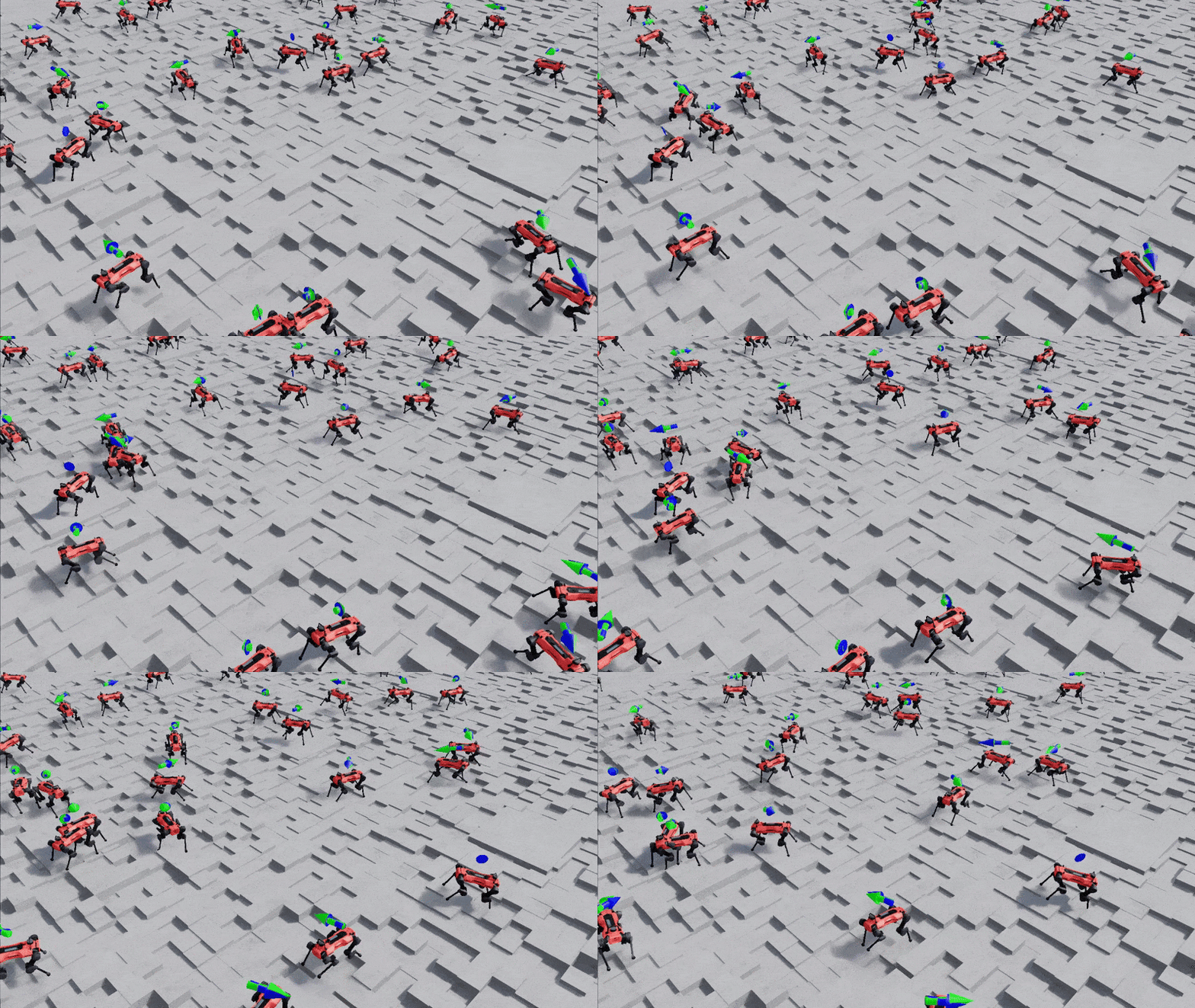
The open-source Visual Asset Management System (VAMS) now supports GPU-accelerated reinforcement learning (RL) for robotic assets through integration with NVIDIA Isaac Lab. This pipeline enables teams to train and evaluate RL policies directly from their asset management workflow, leveraging AWS Batch for scalable GPU compute. Isaac Lab for Physical AI and Robotics Development Figure 1: […]
Embodied AI Blog Series, Part 1: Getting Started with Robot Learning on AWS Batch
Note: This blog was updated on May 6, 2026 We have reached a milestone in technical evolution: the ability to use advanced AI models to influence not only the digital world but also the physical one. We are moving from AI that generates text to AI that moves atoms — augmenting our daily lives by […]