AWS for Industries
FHIR-powered Care Continuum on AWS HealthLake
Healthcare generates more data than almost any other industry, yet most of it remains trapped. It’s siloed in incompatible formats, locked in legacy systems, and inaccessible to the AI-driven applications that could transform patient care. Clinicians piece together fragmented records during 15-minute visits. Payor teams spend hours on prior authorization reviews that should take minutes. Members sit on hold waiting for answers that already exist somewhere in the system.
The root cause isn’t a lack of AI capability. It’s a data foundation problem.
AWS HealthLake is a fully managed, HIPAA-eligible service that serves as an AI-ready FHIR (Fast Healthcare Interoperability Resources) persistence layer. As a unified data foundation, it can power intelligent applications across the entire care continuum: from raw legacy data transformation to population health analytics, clinical decision support, automated prior authorization, and conversational member engagement. HealthLake provides high-throughput APIs that meet CMS (Centers for Medicare & Medicaid Services) and ONC (Office of the National Coordinator for Health Information Technology) compliance requirements while maintaining the performance and reliability proven across hundreds of healthcare customers.
This post explains the vision behind how healthcare organizations can move from fragmented data to a connected, AI-ready future with AWS HealthLake.
The healthcare data problem
Healthcare interoperability has been a goal for decades. While standards like FHIR have made significant progress, the reality on the ground remains challenging.
A typical health system manages data across dozens of formats: HL7 v2 messages from hospital interfaces, C-CDA documents from clinical exchanges, 837 and 835 claims files from payor interactions, and proprietary exports from EHR (Electronic Health Record) systems that were never designed to talk to each other. When organizations merge or acquire physician groups, the data integration challenge multiplies. Integration teams estimate months to normalize this data into something usable.
Meanwhile, the regulatory landscape is accelerating. CMS-0057-F mandates FHIR-based prior authorization. ONC HTI-1 pushes for certified interoperability. The 21st Century Cures Act demands patient access. Organizations need to comply, but compliance alone doesn’t create value. The real opportunity is what becomes possible after the data is right.
This is the gap AWS HealthLake was built to close.
From raw data to intelligent healthcare: the connected story
Rather than showcasing isolated features, we show a single, connected story: “From Raw Data to Intelligent Healthcare.” It follows one patient’s journey across five stages of the care continuum, each powered by the same HealthLake FHIR data foundation.
The narrative was designed to answer a question healthcare leaders ask constantly: “If I invest in a FHIR data foundation, what does it actually unlock?” The answer: everything downstream.
We show that once healthcare data is standardized and stored in HealthLake, it becomes the foundation for population health, clinical intelligence, payor automation, and member engagement, not as separate applications, but as a continuous workflow where each step informs the next.
How AWS HealthLake supports the full care continuum
Making legacy data AI-ready
Every healthcare AI initiative begins and often stalls at data normalization. AWS HealthLake addresses this through its data transformation agent, which uses AI to understand the clinical meaning of incoming data regardless of format, and converts it into properly coded, properly referenced FHIR resources. We’ll go deeper on this capability in the next section.
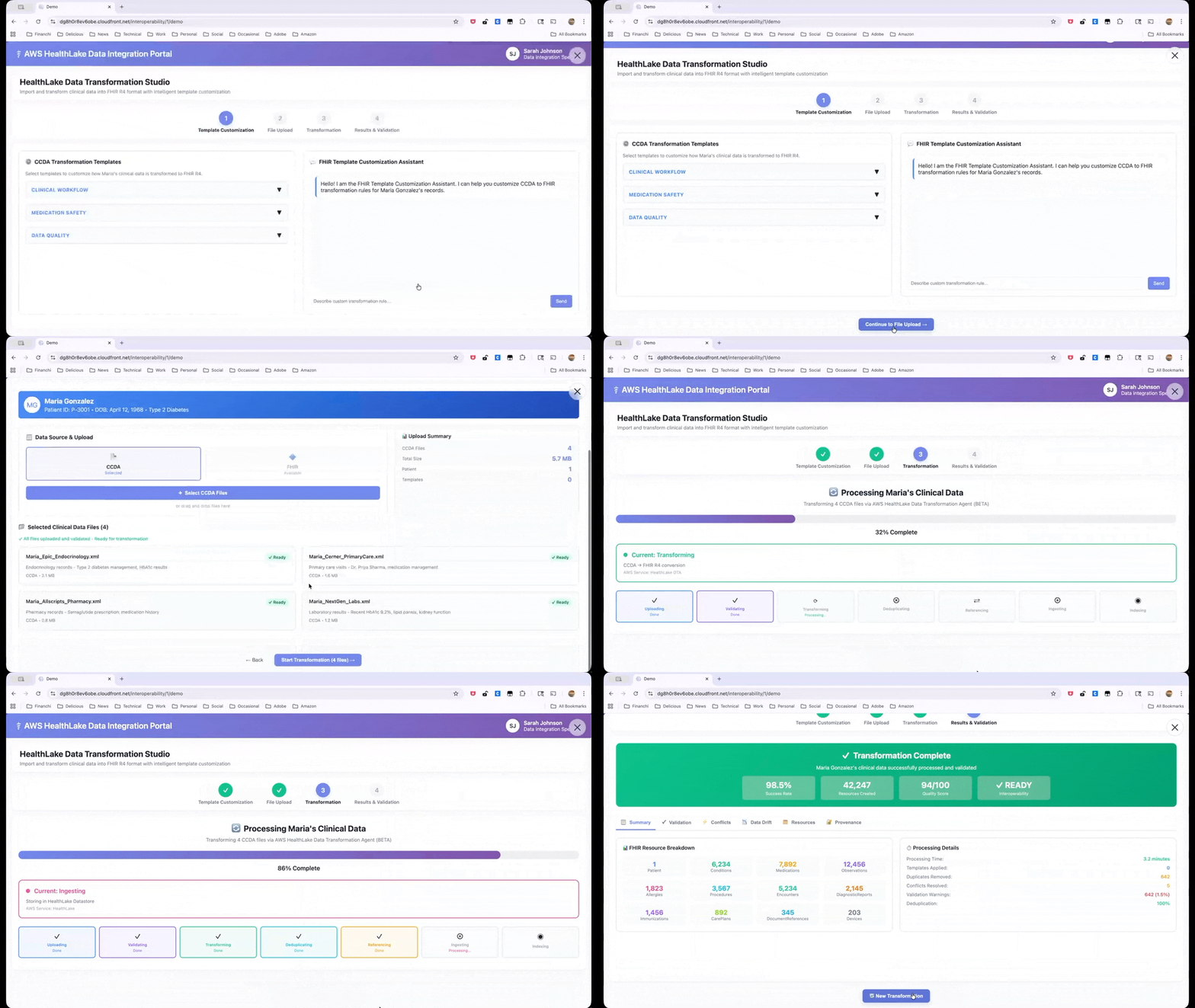
Figure 1 Data transformation agent implementation
FHIR data for real-time, scalable population health analytics
With standardized FHIR data in AWS HealthLake, population health analytics becomes an on-demand capability rather than a quarterly project. Health systems can calculate clinical quality measures such as HEDIS, CMS quality programs, and internal benchmarks across entire patient populations in real time.
An AI agent can query AWS HealthLake via the open-source Model Context Protocol (MCP) Server, retrieve relevant clinical data, apply measure logic, and surface actionable insights, identifying specific patients with specific care gaps and generating prioritized intervention lists with full clinical context. AWS HealthLake’s ability to handle billions of FHIR resources at sub-second latency means population-level queries run against current data, not stale batch extracts.
FHIR data to support clinical applications
At the point of care, the value of a clean FHIR foundation becomes most visible. An AI agent can pull a complete patient 360 from HealthLake including active conditions, medications, lab trends, social determinants of health, and care gaps identified at the population level, and generate contextual, prioritized next-best-action recommendations with clinical reasoning.
HealthLake’s built-in natural language processing (NLP) capabilities enrich this further by extracting clinical context from unstructured medical text, ensuring that information buried in clinical notes becomes part of the computable patient record. For clinicians with their busy schedule and a complex patient, this is the difference between scrambling through fragmented screens and walking into the room with a clear plan.
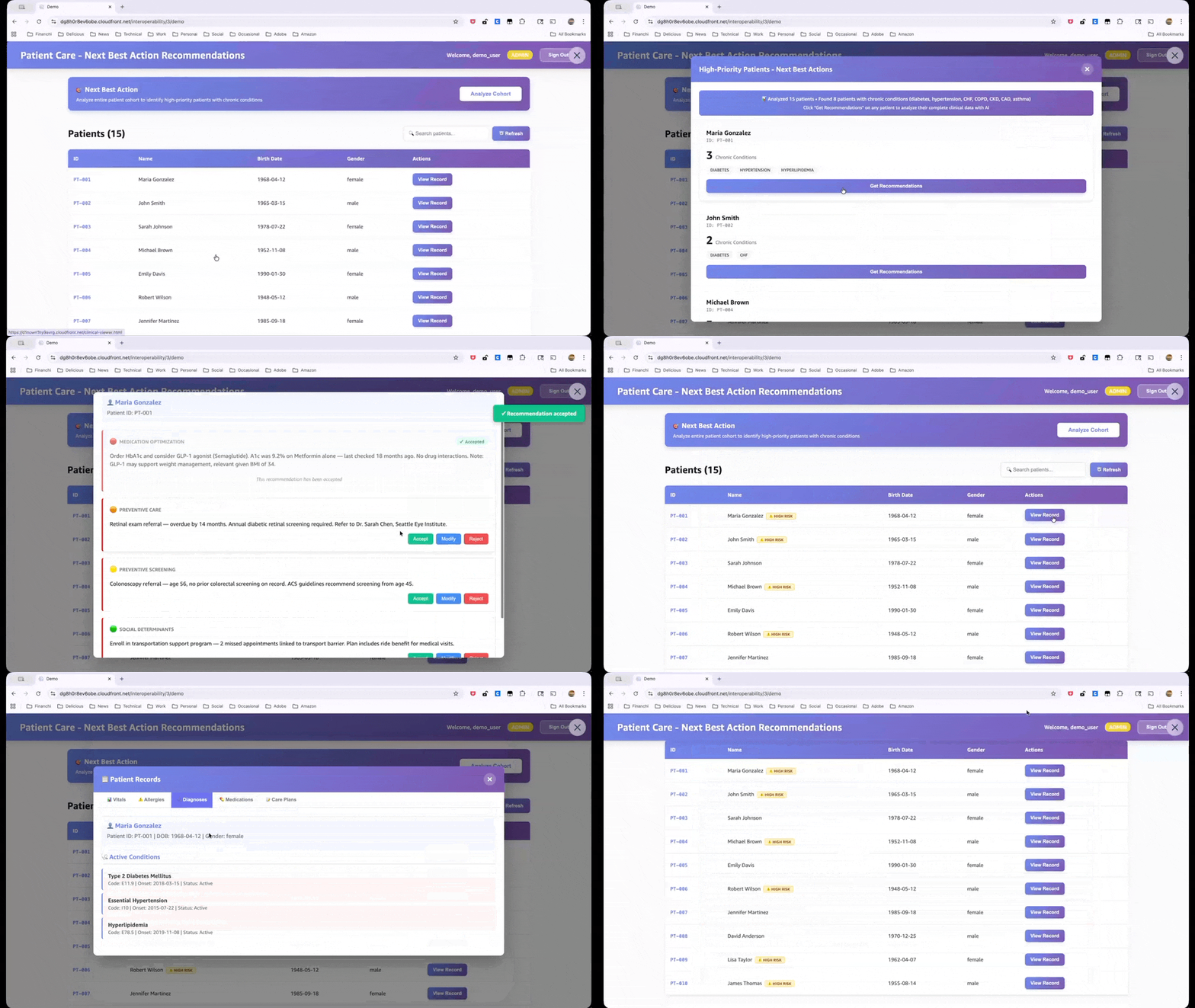
Figure 2 Patient care: next best action
Payor operations: Intelligent prior authorization
The same FHIR data that informs clinical decisions flows seamlessly into payor workflows. When a clinician orders a medication or procedure requiring prior authorization, the complete clinical context is already available in AWS HealthLake. An AI agent can retrieve the member’s history, apply medical necessity criteria, evaluate supporting evidence, and generate a determination with clinical rationale and audit trail in FHIR format.
This transforms prior authorization from a manual, adversarial process that delays care into an intelligent, data-driven workflow where clinical evidence speaks for itself. Complex cases are routed to human reviewers, but they arrive with complete context.
Member engagement: Conversational access to care
The final stage, and often the most neglected, is the member experience. Patients have straightforward questions: Was my medication approved? What will it cost? Where’s the nearest pharmacy? These answers already exist in the FHIR data. AWS HealthLake, combined with the MCP Server and Amazon Bedrock AgentCore, enables conversational AI interfaces that retrieve and synthesize this information in natural language, and proactively surface care gaps or benefit information the member didn’t know to ask about.
This is where the full circle becomes visible. A care gap identified at the population level, addressed by a clinician, authorized by the payor, and communicated to the member in a brief conversation, all powered by the same data foundation.
Data transformation agent in AWS HealthLake
If AWS HealthLake is the foundation, the data transformation agent is the on-ramp. It addresses what we call healthcare’s “first-mile problem”: the gap between where data exists today and where it needs to be for AI and analytics to work.
What the data transformation agent does
Launched in preview on March 5, 2026, the AWS HealthLake data transformation agent (preview) enables healthcare organizations to transform legacy clinical documents into queryable FHIR resources in days instead of months, unlocking use cases such as longitudinal patient record generation, population health analytics, and clinical data exchange.
The data transformation agent is an AI-powered capability that converts Consolidated Clinical Document Architecture (C-CDA) files into FHIR R4-compliant resources without requiring specialized FHIR expertise. It combines real-time conversion testing, AI-assisted template customization, and scalable bulk import into an integrated experience.
How it works
The data transformation agent includes ready-to-use templates for C-CDA 2.1 to FHIR R4 conversion. The workflow is straightforward:
Test and validate. Submit individual C-CDA files through a synchronous conversion API or the console and receive transformed FHIR Bundles in seconds. Preview results, validate conversion quality interactively, and sign off on templates before production use.
Customize with AI assistance. When default templates need adjustment, the data transformation agent offers an AI-powered experience to customize them directly in the console. Describe changes in natural language such as “skip medications with status entered-in-error” or “map procedure dates to performedDateTime instead of performedPeriod” and the AI agent modifies the underlying template automatically. Manual curation is also available for power users who prefer targeted edits. Test against sample files, iterate conversationally, and publish once satisfied.
Import at scale. An enhanced import workflow automatically detects uploaded C-CDA files, applies the active template, matches and reconciles patients based on identifiers, and ingests the resulting FHIR resources into the target HealthLake datastore with detailed logs. All capabilities are available both on the AWS console and programmatically via API for integration into existing workflows.
Why this matters
Healthcare data transformation has traditionally been an ETL (Extract, Transform, Load) exercise: teams of interface engineers manually mapping fields from source formats to target schemas. Every new data source requires new mappings. Every source system upgrade risks breaking existing integrations. The work is labor-intensive, brittle, and slow.
The data transformation agent in AWS HealthLake takes a different approach. By combining ready-to-use templates with AI-assisted customization and scalable bulk import, it compresses what has historically been a months-long project into days. Organizations pursuing AI, analytics, value-based care, or regulatory compliance all hit the same wall. Their data isn’t ready. The data transformation agent removes that wall.
Architecture

Figure 3 FHIR-powered care continuum on AWS HealthLake
The architecture centers on AWS HealthLake as the FHIR R4 datastore, the single source of truth for all clinical, claims, and administrative data. The open-source AWS HealthLake MCP Server provides the standardized interface layer that enables AI agents to interact with this data through natural language. Amazon Bedrock powers the foundation models that drive clinical reasoning and intelligent decision support across all use cases.
The MCP Server provides comprehensive FHIR operations (create, read, update, delete, search), automatic datastore discovery, advanced healthcare workflows (patient-everything operations, FHIR job management), and a security-first design with read-only mode for production environments.
For enterprise healthcare environments requiring integration with multiple clinical systems, Amazon Bedrock AgentCore serves as the unified connectivity layer, transforming existing healthcare APIs and services into MCP-compatible tools so that agents can access AWS HealthLake data alongside electronic health records, medical imaging systems, and other clinical tools through a single, standardized interface.
This architecture ensures that every agent, every workflow, and every insight draws from the same trusted FHIR foundation consistently, reliably, and at scale.
Security and compliance
Healthcare data demands the highest standards of security and governance. This architecture is built on principles that are non-negotiable in healthcare:
Data protection and access control:
- AWS HealthLake is a HIPAA-eligible service with encryption at rest and in transit
- The MCP Server includes read-only mode that blocks all mutating operations while preserving full query capabilities essential for production environments and auditing
- AWS IAM provides granular authentication and authorization following least-privilege principles
- AWS SigV4 authentication with automatic credential handling across multiple authentication methods
Audit and regulatory compliance:
- AWS CloudTrail integration provides comprehensive audit logging for every data access and operation
- FHIR-formatted audit trails are generated automatically for clinical workflows
- Built-in support for CMS-0057-F, CMS-9115-F, ONC HTI-1, and the 21st Century Cures Act
Operational governance:
- AWS HealthLake’s fully managed infrastructure eliminates the security burden of self-managed FHIR servers
- The MCP Server’s security-first design ensures AI agents operate within defined boundaries with explicit controls over permitted operations
Conclusion
We set out to demonstrate what the healthcare industry has been working toward: a single data foundation powering intelligent applications across the entire care continuum.
Legacy data trapped in incompatible formats across disparate systems transforms into a clean FHIR foundation. That foundation immediately unlocks population health analytics, clinical decision support, intelligent payor operations, and conversational member engagement. Each capability builds on the one before it. Each draws from the same data.
This is what AWS HealthLake was built for. It doesn’t just store FHIR data, but also makes the data actionable at scale through natural language interfaces that put the power of the data in the hands of clinicians, quality officers, payor teams, and patients.
The era of fragmented healthcare data doesn’t have to continue. The foundation is ready.