Artificial Intelligence
Tag: AIML
Embed a live AI browser agent in your React app with Amazon Bedrock AgentCore
This post walks you through three steps: starting a session and generating the Live View URL, rendering the stream in your React application, and wiring up an AI agent that drives the browser while your users watch. At the end, you will have a working sample application you can clone and run.
Train CodeFu-7B with veRL and Ray on Amazon SageMaker Training jobs
In this post, we demonstrate how to train CodeFu-7B, a specialized 7-billion parameter model for competitive programming, using Group Relative Policy Optimization (GRPO) with veRL, a flexible and efficient training library for large language models (LLMs) that enables straightforward extension of diverse RL algorithms and seamless integration with existing LLM infrastructure, within a distributed Ray cluster managed by SageMaker training jobs. We walk through the complete implementation, covering data preparation, distributed training setup, and comprehensive observability, showcasing how this unified approach delivers both computational scale and developer experience for sophisticated RL training workloads.
Scale LLM fine-tuning with Hugging Face and Amazon SageMaker AI
In this post, we show how this integrated approach transforms enterprise LLM fine-tuning from a complex, resource-intensive challenge into a streamlined, scalable solution for achieving better model performance in domain-specific applications.
Using Strands Agents to create a multi-agent solution with Meta’s Llama 4 and Amazon Bedrock
In this post, we explore how to build a multi-agent video processing workflow using Strands Agents, Meta’s Llama 4 models, and Amazon Bedrock to automatically analyze and understand video content through specialized AI agents working in coordination. To showcase the solution, we will use Amazon SageMaker AI to walk you through the code.
Move Beyond Chain-of-Thought with Chain-of-Draft on Amazon Bedrock
This post explores Chain-of-Draft (CoD), an innovative prompting technique introduced in a Zoom AI Research paper Chain of Draft: Thinking Faster by Writing Less, that revolutionizes how models approach reasoning tasks. While Chain-of-Thought (CoT) prompting has been the go-to method for enhancing model reasoning, CoD offers a more efficient alternative that mirrors human problem-solving patterns—using concise, high-signal thinking steps rather than verbose explanations.
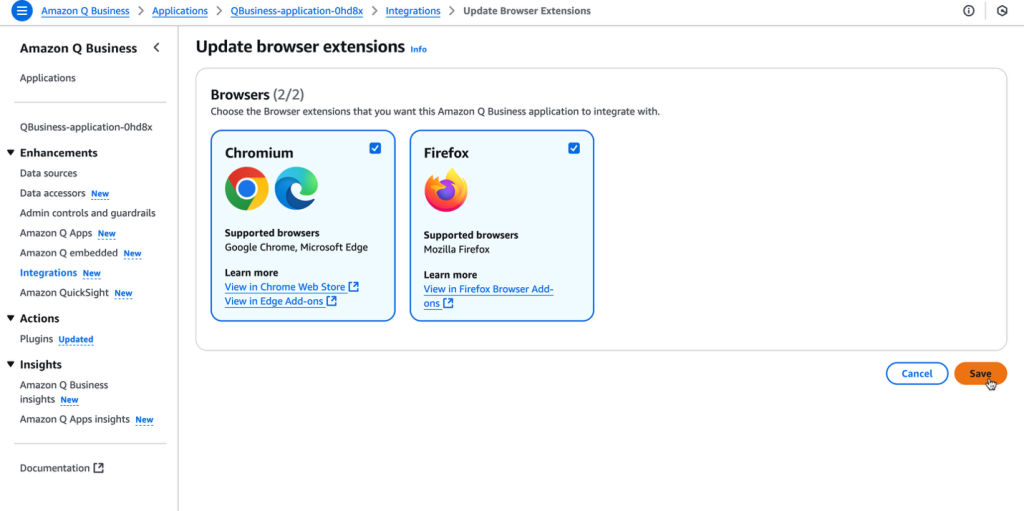
Supercharge your organization’s productivity with the Amazon Q Business browser extension
In this post, we showed how to use the Amazon Q Business browser extension to give your team seamless access to AI-driven insights and assistance. The browser extension is now available in US East (N. Virginia) and US West (Oregon) AWS Regions for Mozilla, Google Chrome, and Microsoft Edge as part of the Lite Subscription.
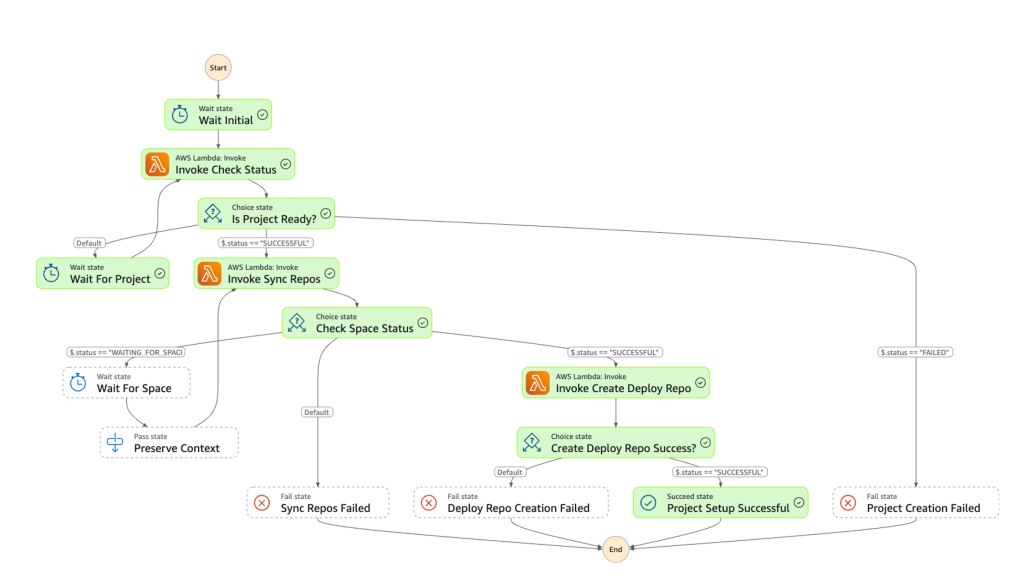
Automate ModelOps with SageMaker Unified Studio, Part 2: Technical implementation
In this post, we focus on implementing this architecture with step-by-step guidance and reference code. We provide a detailed technical walkthrough that addresses the needs of two critical personas in the AI development lifecycle: the administrator who establishes governance and infrastructure through automated templates, and the data scientist who uses SageMaker Unified Studio for model development without managing the underlying infrastructure.

Automate ModelOps with Amazon SageMaker Unified Studio, Part 1: Solution architecture
This post presents architectural strategies and a scalable framework that helps organizations manage multi-tenant environments, automate consistently, and embed governance controls as they scale their AI initiatives with SageMaker Unified Studio.

End-to-End model training and deployment with Amazon SageMaker Unified Studio
In this post, we guide you through the stages of customizing large language models (LLMs) with SageMaker Unified Studio and SageMaker AI, covering the end-to-end process starting from data discovery to fine-tuning FMs with SageMaker AI distributed training, tracking metrics using MLflow, and then deploying models using SageMaker AI inference for real-time inference. We also discuss best practices to choose the right instance size and share some debugging best practices while working with JupyterLab notebooks in SageMaker Unified Studio.
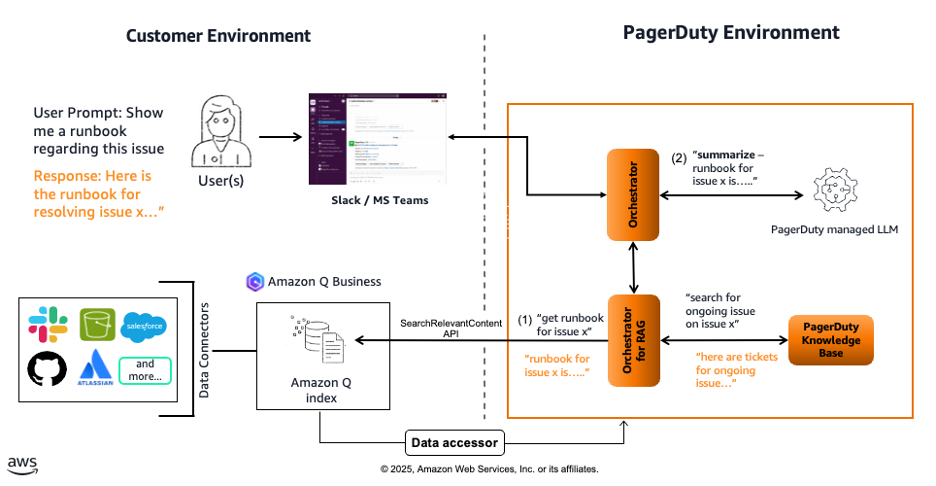
Extend your Amazon Q Business with PagerDuty Advance data accessor
In this post, we demonstrate how organizations can enhance their incident management capabilities by integrating PagerDuty Advance, an innovative set of agentic and generative AI capabilities that automate response workflows and provide real-time insights into operational health, with Amazon Q Business. We show how to configure PagerDuty Advance as a data accessor for Amazon Q indexes, so you can search and access enterprise knowledge across multiple systems during incident response.