Artificial Intelligence
Category: Learning Levels
Build AI agents for business intelligence with Amazon Bedrock AgentCore
In this post, we show you how OPLOG developed three AI agents using the Strands Agents SDK, deployed them to Amazon Bedrock AgentCore, and integrated Amazon Bedrock with Anthropic’s Claude Sonnet and Amazon Bedrock Knowledge Bases for Retrieval Augmented Generation (RAG).
Build an AI-powered recruitment assistant using Amazon Bedrock
In this post, we demonstrate how to build an AI-powered recruitment assistant using Amazon Bedrock that brings efficiencies to candidate evaluation, generates personalized interview questions, and provides data-driven insights for human hiring decisions. This post presents a reference architecture for learning purposes — not a production-ready solution. Amazon Bedrock and the AWS services used here are general-purpose tools that customers can combine to support a wide variety of use cases, including recruitment workflows. The architecture demonstrates one possible approach; customers should adapt it to their specific requirements.
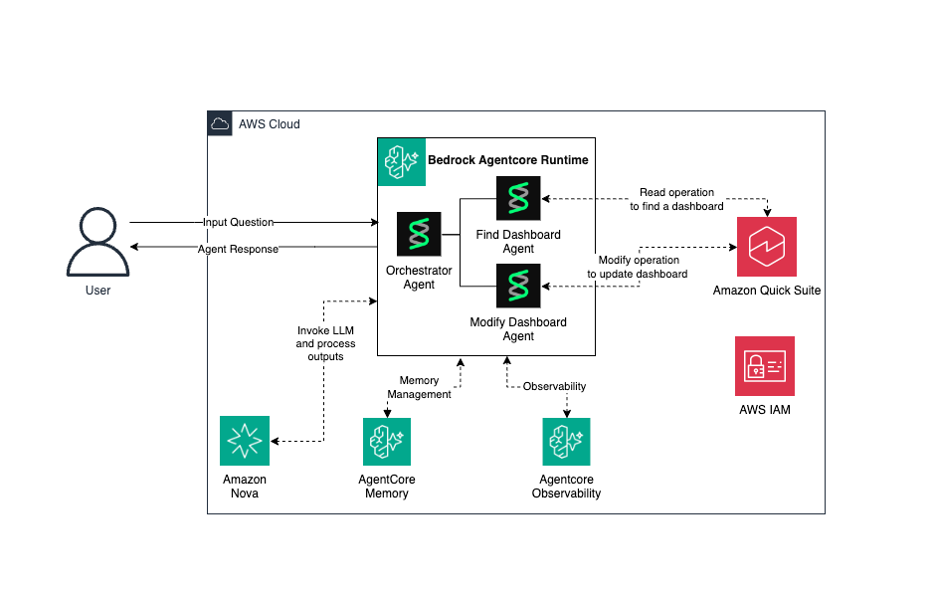
Build AI-powered dashboard automation agents with NLP on Amazon Bedrock AgentCore
This solution combines the power of Amazon Bedrock AgentCore, Strands Agents, and Amazon Quick transforms to deliver a secure, scalable, and intelligent system for building and operating AI agents while transforming data into actionable business insights.
Announcing OpenAI-compatible API support for Amazon SageMaker AI endpoints
Today, Amazon SageMaker AI introduces OpenAI-compatible API support for real-time inference endpoints. If you use the OpenAI SDK, LangChain, or Strands Agents, you can now invoke models on SageMaker AI by changing only your endpoint URL. You don’t need a custom client, a SigV4 wrapper, or code rewrites. Overview With this launch, SageMaker AI endpoints […]
Extending conversational memory in Kiro CLI using Amazon Bedrock AgentCore Memory
In this post, we demonstrate how you can extend the conversational memory of Kiro CLI by implementing a custom Model Context Protocol (MCP) server that integrates with Amazon Bedrock AgentCore Memory. You can use Kiro CLI to interact with AI agents of Kiro directly from your terminal. Amazon Bedrock AgentCore Memory is a fully managed service that allows AI agents to retain information from past interactions, creating more intelligent and context-aware conversations. By implementing a custom MCP server, you can provide Kiro CLI with tools to store and retrieve conversation context, monitor memory usage, and manage the underlying Bedrock Agent Core Memory infrastructure.
Accelerate ML feature pipelines with new capabilities in Amazon SageMaker Feature Store
Today, we’re announcing three new capabilities available in SageMaker Python SDK v3.8.0. In this post, we walk through each capability with code examples you can use to get started. For complete end-to-end walkthroughs, see the accompanying notebooks for Lake Formation governance and Iceberg table properties in the SageMaker Python SDK repository.
Prompting Amazon Nova 2 for content moderation
In this post, you learn how to prompt Amazon Nova 2 Lite for content moderation using structured and free-form approaches, grounded in the MLCommons AILuminate Assessment Standard. The prompting techniques use the AILuminate taxonomy as an example, but they work equally well with your own custom moderation policy. You can swap in your own category definitions and the prompt structure stays the same. We also benchmark the content moderation capabilities of Amazon Nova 2 Lite against several foundation models (FMs) on three public datasets.
Build custom code-based evaluators in Amazon Bedrock AgentCore
In this post, you will implement four Lambda-based custom code evaluators for a financial market-intelligence agent, register each with AgentCore, and run them in on-demand and online modes. You will also see how to combine custom code-based evaluators with built-in evaluators and how to call other AWS services for grounded fact-checking, PII detection, and real-time alerting.
Restrict access to sensitive documents in your Amazon Quick knowledge bases for Amazon S3
In this post, we walk through how to configure document-level ACLs for your S3 knowledge base in Amazon Quick. You will learn how to set up and verify an ACL configuration that enforces document-level permissions across chat and automated workflows.
Control where your AI agents can browse with Chrome enterprise policies on Amazon Bedrock AgentCore
In this post, you will configure Chrome enterprise policies to restrict a browser agent to a specific website, observe the policy enforcement through session recording, and demonstrate custom root CA certificates using a public test site. The walkthrough produces a working solution that researches Amazon Bedrock AgentCore documentation while operating under enterprise browser restrictions.