AWS Database Blog
Ensuring consistent performance after major version upgrades with Amazon Aurora PostgreSQL Query Plan Management
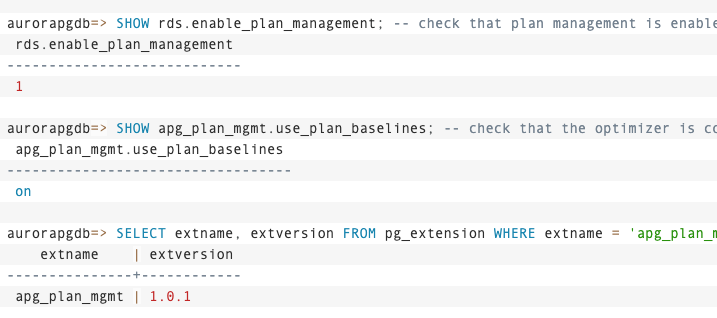
Keeping your database version up to date provides benefits like improved performance and security, access to new features, fixes to known issues, compliance with regulatory requirements, and more. However, there is also a risk of some queries experiencing performance regression following a database upgrade. This risk is higher with major version upgrades because they can […]

Monitoring metrics and setting up alarms on your Amazon DocumentDB (with MongoDB compatibility) clusters
Amazon DocumentDB (with MongoDB compatibility) is a fast, scalable, highly available, and fully managed document database service that supports MongoDB workloads. You can use the same MongoDB 4.0 or 5.0 application code, drivers, and tools to run, manage, and scale workloads on Amazon DocumentDB without having to worry about managing the underlying infrastructure. As a […]

Best practices for using a MySQL read replica to upgrade an Amazon RDS for MySQL database
December, 2022: Amazon Relational Database Service (Amazon RDS) now supports Amazon RDS Blue/Green Deployments to help you with safer, simpler, and faster updates to your Amazon Aurora and Amazon RDS databases. Blue/Green Deployments create a fully managed staging environment that allows you to deploy and test production changes, keeping your current production database safe. Learn […]

2020: The year in review for Amazon DynamoDB
2020 has been another busy year for Amazon DynamoDB. We released new and updated features that focus on making your experience with the service better than ever in terms of reliability, encryption, speed, scale, and flexibility. The following 2020 releases are organized alphabetically by category and then by dated releases, with the most recent release […]

Migrating an on-premises SQL Server database to Amazon RDS on VMware using SQL Server native backup and restore
Amazon Relational Database Service (Amazon RDS) on VMware delivers managed SQL Server databases in on-premises VMware environments. Managing SQL Server can be complex and time-consuming, but RDS on VMware makes it easy to provision, scale, and operate SQL Server in VMware vSphere clusters. You can migrate your existing on-premises SQL Server databases to RDS on […]

Federated query support for Amazon Aurora PostgreSQL and Amazon RDS for PostgreSQL – Part 1
PostgreSQL is one of the most widely used database engines and is supported by a very large and active community. It’s a viable open-source option to use compared to many commercial databases, which require heavy license costs. Amazon Relational Database Service (Amazon RDS) for PostgreSQL and Amazon Aurora PostgreSQL-Compatible Edition are AWS managed offerings that […]

Resetting your graph data in Amazon Neptune in seconds
As an enterprise application developer building graph applications with Amazon Neptune, you may want to delete and reload your graph data on a regular basis to make sure you’re working with the latest changes in your data, such as new relationships between nodes, or to replace test data with production data. In the past, you […]

Amazon DocumentDB (with MongoDB compatibility) read autoscaling
Amazon Document DB (with MongoDB compatibility) is a fast, scalable, highly available, and fully managed document database service that supports MongoDB workloads. Its architecture supports up to 15 read replicas, so applications that connect as a replica set can use driver read preference settings to direct reads to replicas for horizontal read scaling. Moreover, as […]

Migrating SQL Server to Amazon RDS using native backup and restore
September 2025: This post was reviewed for accuracy. Running Microsoft SQL Server on Amazon Relational Database Service (Amazon RDS) automates time-consuming administration tasks such as installation, disk provisioning and management, patching, minor and major version upgrades, and backup and recovery of your SQL Server databases. Amazon RDS also offers high availability using a Multi-AZ solution, […]

Building a knowledge graph with topic networks in Amazon Neptune
This is a guest blog post by By Edward Brown, Head of AI Projects, Eduardo Piairo, Architect, Marcia Oliveira, Lead Data Scientist, and Jack Hampson, CEO at Deeper Insights. We originally developed our Amazon Neptune-based knowledge graph to extract knowledge from a large textual dataset using high-level semantic queries. This resource would serve as the […]