AWS Database Blog

Upgrading from Amazon RDS for MySQL version 5.5
Amazon Relational Database Service (Amazon RDS) for MySQL 5.5 major version is reaching end of life, and it’s recommended to upgrade to newer supported major versions. Amazon Relational Database Service (Amazon RDS) provides newer versions of databases so you can keep your DB instances up to date. These versions include bug fixes, security enhancements, and […]

Migrating SQL Server databases from Microsoft Azure to AWS in near-real time with CloudBasic
There are multiple ways to migrate SQL Server databases hosted in Microsoft Azure into Amazon Relational Database Service (Amazon RDS) for SQL Server. For use cases such as migrating from SQL Server on an Azure virtual machine to Amazon RDS for SQL Server or SQL on Amazon Elastic Compute Cloud (Amazon EC2), you can use […]

Building a knowledge graph in Amazon Neptune using Amazon Comprehend Events
On 28-Oct-22, the AWS CloudFormation template and Jupyter notebook linked in this post were updated to 1/ add openCypher queries along with the existing Gremlin and SPARQL queries, 2/ updated to use Sagemaker newer Amazon Linux 2 instances, 3/ fixed a bug in the RDF generation code that improperly labeled a property as an RDF […]

Enabling low code graph data apps with Amazon Neptune and Graphistry
One of the common challenges to unlocking the value of graph databases is building easy-to-use, customer-facing data tools that expose graph-powered insights in impactful and visual ways. Data engineers need to inspect data quality, data scientists need to perform discovery and inspect models, analysts need to investigate connections, and managers need insight into what’s going […]
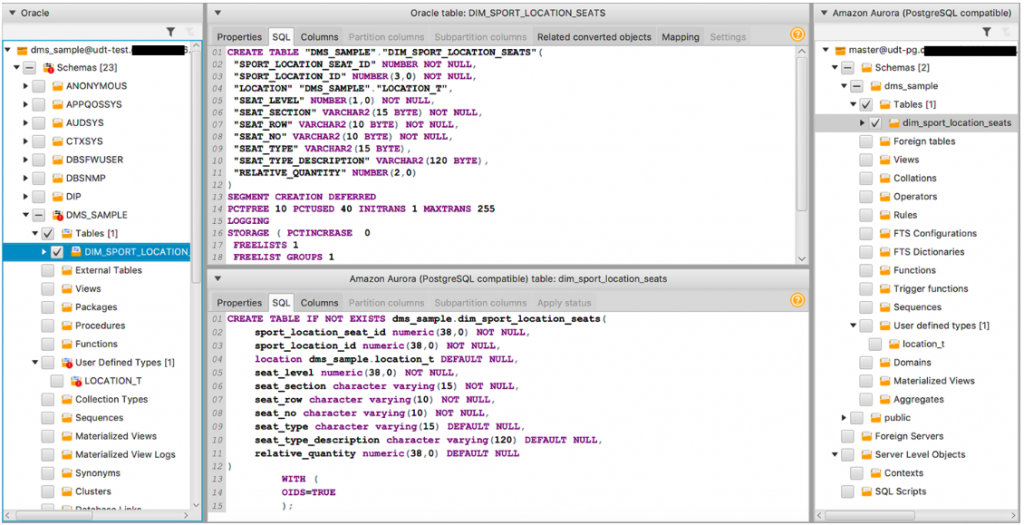
Migrating user-defined types from Oracle to PostgreSQL
Migrating from commercial databases to open source is a multistage process with different technologies, starting from assessment, data migration, data validation, and cutover. One of the key aspects for any heterogenous database migration is data type conversion. In this post, we show you a step-by-step approach to migrate user-defined types (UDT) from Oracle to Amazon […]

Using external Kerberos authentication with Amazon Aurora PostgreSQL
In the first post in this series, Preparing on-premises and AWS environments for external Kerberos authentication for Amazon RDS, we built the infrastructure for a one-way forest trust between an on-premises Microsoft Active Directory (AD) domain (trust: incoming) and an AWS Managed Microsoft AD domain (trust: outgoing) provided by AWS Directory Service. In this post, […]

Using external Kerberos authentication with Amazon RDS for Oracle
In the first post in this series, Preparing on-premises and AWS environments for external Kerberos authentication for Amazon RDS, we built the infrastructure for a one-way forest trust between an on-premises Microsoft Active Directory (AD) domain (trust: incoming) and an AWS Managed Microsoft AD domain (trust: outgoing) provided by AWS Directory Service. In this post, […]

Using external Kerberos authentication with Amazon RDS for PostgreSQL
In the first post in this series, Preparing on-premises and AWS environments for external Kerberos authentication for Amazon RDS, we built the infrastructure for a one-way forest trust between an on-premises Microsoft Active Directory (AD) domain (trust: incoming) and an AWS Managed Microsoft AD domain (trust: outgoing) provided by AWS Directory Service. In this post, […]

Preparing on-premises and AWS environments for external Kerberos authentication for Amazon RDS
As database security becomes more and more essential to the success of a business, managing user access to databases effectively has always been a challenge to database administrators (DBAs) and security officers. Traditional database authentication is based on a username-password mechanism. This method unfortunately requires effort from both DBAs and users to maintain the credentials; […]

Automatic upgrades of Amazon RDS for MariaDB versions 10.0 and 10.1 to begin March 9, 2021
MariaDB Server is one of the world’s most popular open source relational databases. It is available in the standard repositories of all major Linux and Windows distributions. The MariaDB Foundation ensures a steady cadence of releases. On average, MariaDB Server has had one stable major release every year. The current supported versions are 10.2, 10.3, […]