Containers
Category: Learning Levels

Announcing Amazon ECS Task Definition Deletion
Today, we are happy to announce new functionality in Amazon Elastic Container Services (Amazon ECS) that allows you to delete task definition revisions. Until now, you were only able to deregister a task definition revision and it would no longer display in your ListTaskDefinition API calls or in your Amazon ECS console, unless you specifically […]

Deploying Amazon EKS Windows managed node groups
Introduction To help customers run their Windows applications in a more streamlined manner, we launched the support for Amazon EKS Managed Node Group (MNG) support for Windows containers on December 15, 2022. Amazon Elastic Kubernetes Service (Amazon EKS) MNGs automate the provisioning and lifecycle management of nodes (Amazon Elastic Compute Cloud [Amazon EC2] instances) for […]

Amazon EKS now supports Kubernetes version 1.25
Introduction The Amazon Elastic Kubernetes Service (Amazon EKS) team is pleased to announce support for Kubernetes version 1.25 for Amazon EKS and Amazon EKS Distro. Amazon EKS Anywhere (release 0.14.2) also supports Kubernetes 1.25. The theme for this version was chosen to recognize both the diverse components that the project comprises and the individuals who […]

Kubernetes as a platform vs. Kubernetes as an API
Introduction What is Kubernetes? I have been working on this technology since the beginning and after 8 years, I’m still having a problem defining what it is. Some people define Kubernetes as a container orchestrator but does that definition capture the essence of Kubernetes? I don’t think so. In this post, I’d like to explore […]

Optimizing your Kubernetes compute costs with Karpenter consolidation
Introduction Karpenter was built to solve issues pertaining to optimal node selection in Kubernetes. Karpenter’s what-you-need-when-you-need-it model simplifies the process of managing compute resources in Kubernetes by adding compute capacity to your cluster based on a pod’s requirements. With the recent release of workload consolidation, Karpenter can now be enabled to continuously monitor and optimize […]

EKS Persistent Volumes for Instance Store
The Kubernetes project is made up of a number of special interest groups (SIGs) that focus on a particular part of the Kubernetes ecosystem. The Storage SIG is focused on different types of storage (block and file) and ensuring that storage is available to containers when they are scheduled. One of the subprojects of the Storage […]
Continuous Delivery of Amazon EKS Clusters Using AWS CDK and CDK Pipelines
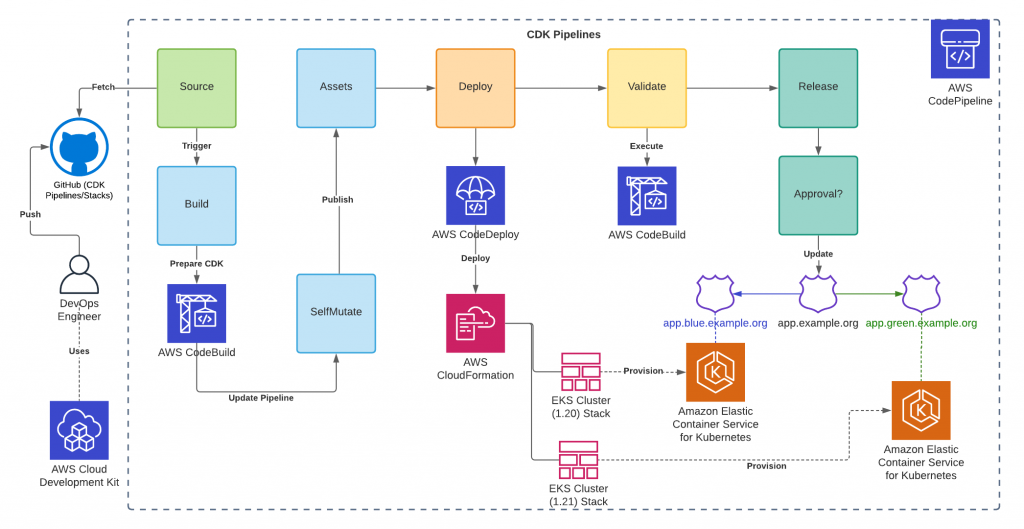
This blog is no longer up to date and we recommend reviewing the Amazon EKS Blueprints for CDK Pipeline SDK module which makes it easier to create infrastructure Continuous Delivery pipelines via AWS CodePipeline. Customers are looking for ways to automate the deployment of their Amazon EKS clusters across different versions, environments, accounts, and Regions. […]

Cloud Native CI/CD with Tekton and ArgoCD on AWS
Introduction With the ongoing popularity and adoption of container orchestrators such as Kubernetes, more and more cloud-native applications are built on top of it. Besides business applications, companies are migrating their infrastructure-related components such as CI/CD systems as well. But are those systems ready for such modern platforms? The answer depends. Clearly, most of the […]

Controlling and monitoring AWS App Runner applications with Amazon EventBridge
Many applications do not need to be available 24/7, such as those in development and QA environments. AWS App Runner supports this and allows applications to be paused, or deactivated, to lower costs when not in use. The applications can then be resumed or activated when they are needed. This blog post uses this example […]

Amazon ECS on AWS Outposts
AWS Outposts is a fully managed service that offers the same AWS infrastructure, AWS services, APIs, and tools to virtually any data center, co-location space, or on-premises facility, in the form of a physical rack connected to the AWS global network. AWS compute, storage, database, and other services run locally on Outposts, and you can […]